
the $10m training program no one finished
Completion rate: 12%.
Best-in-class platforms. Curated content. Internal academies. The works.
Still: 12%.
"Engagement issue," someone said.
"Lack of discipline," said another.
Then my 11-year-old quit playing video games.
Not because he was bored. Because he'd discovered something better, he started building them instead. One evening, I asked why. His answer was simple: "Playing is fun. But making a game that other people play? Way cooler."
He didn't care about learning game design. He cared about creation. Ownership. Seeing his work used by real people. Maybe even earning from it.
The learning? Just a means to that end. That one sentence explained more about skill gaps than most strategy decks ever could.
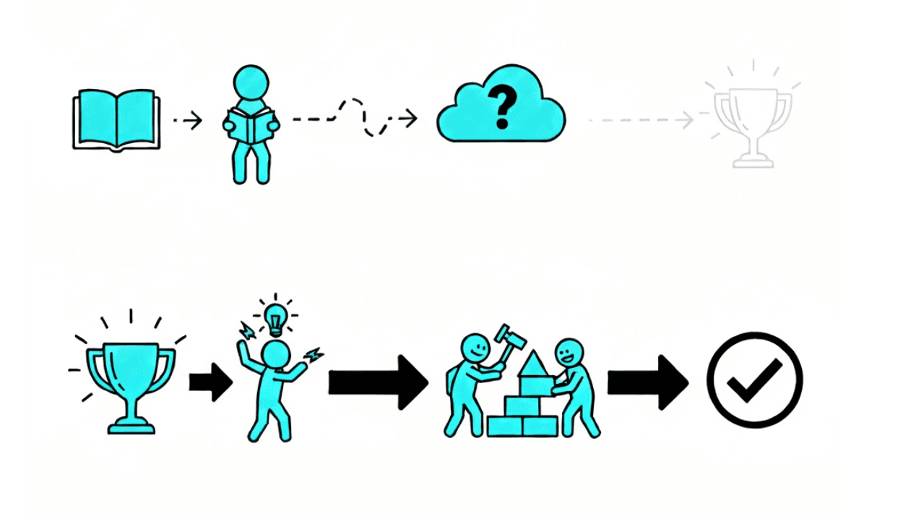
We've been designing learning backwards.
We start with: What should people learn?
Tools. Frameworks. Competencies.
But we skip the only question that actually drives behavior:
What will I be able to build, ship, or influence when this is done?
Not "you'll gain skills in microservices architecture."
But: "You'll be able to deploy a feature that serves 10M users by Friday."
Not "you'll understand data pipelines."
But: "You'll cut infrastructure costs by 40% and leadership will ask how you did it."
Concrete. Visible. Valuable.
The gap isn't knowledge. It's motivation architecture.
A teenager can learn complex game engines because the outcome is immediate and real. They publish. They iterate. They see people play what they built.
Learning and business value are tightly coupled; the feedback is instant, even if unintentional. Corporate upskilling? We ask people to invest 20 hours now for abstract value later. From a business lens, that's not just an engagement problem. It's an ROI problem.
Here's what changes when you flip the design:
Show the end state first. Make it tangible.
• This is the dashboard you'll build.
• This is the process you'll automate.
• This is the pitch you'll deliver, and win.
Then learning stops being an obligation. It becomes leverage.
My son didn't need convincing to learn Roblox Studio. He needed to see what he could create. Once that was clear, motivation became self-sustaining.
That's not a parenting hack. That's a core instructional design principle, and we keep ignoring it at scale.
If we want to close the skill gap, we need to design learning like we design products:
• Start with value.
• Show impact early.
• Let learning pull itself forward.
Otherwise, we'll keep building programs that get 12% completion rates.
And wondering why the gap keeps growing.
Completion rate: 12%.
Best-in-class platforms. Curated content. Internal academies. The works.
Still: 12%.
"Engagement issue," someone said.
"Lack of discipline," said another.
Then my 11-year-old quit playing video games.
Not because he was bored. Because he'd discovered something better, he started building them instead. One evening, I asked why. His answer was simple: "Playing is fun. But making a game that other people play? Way cooler."
He didn't care about learning game design. He cared about creation. Ownership. Seeing his work used by real people. Maybe even earning from it.
The learning? Just a means to that end. That one sentence explained more about skill gaps than most strategy decks ever could.
We've been designing learning backwards.
We start with: What should people learn?
Tools. Frameworks. Competencies.
But we skip the only question that actually drives behavior:
What will I be able to build, ship, or influence when this is done?
Not "you'll gain skills in microservices architecture."
But: "You'll be able to deploy a feature that serves 10M users by Friday."
Not "you'll understand data pipelines."
But: "You'll cut infrastructure costs by 40% and leadership will ask how you did it."
Concrete. Visible. Valuable.
The gap isn't knowledge. It's motivation architecture.
A teenager can learn complex game engines because the outcome is immediate and real. They publish. They iterate. They see people play what they built.
Learning and business value are tightly coupled; the feedback is instant, even if unintentional. Corporate upskilling? We ask people to invest 20 hours now for abstract value later. From a business lens, that's not just an engagement problem. It's an ROI problem.
Here's what changes when you flip the design:
Show the end state first. Make it tangible.
• This is the dashboard you'll build.
• This is the process you'll automate.
• This is the pitch you'll deliver, and win.
Then learning stops being an obligation. It becomes leverage.
My son didn't need convincing to learn Roblox Studio. He needed to see what he could create. Once that was clear, motivation became self-sustaining.
That's not a parenting hack. That's a core instructional design principle, and we keep ignoring it at scale.
If we want to close the skill gap, we need to design learning like we design products:
• Start with value.
• Show impact early.
• Let learning pull itself forward.
Otherwise, we'll keep building programs that get 12% completion rates.
And wondering why the gap keeps growing.