
Remote work scales. What it scales is up to you.
Remote work scales. What it scales is up to you.
Team struggles with remote work. Immediate reaction: "Everyone back to the office," or "We need better tools."
Wrong diagnosis.
Remote work doesn't create problems. It exposes them. It's a multiplier of whatever structure you already have.
Good structure? You scale delivery.
Unclear ownership? You scale confusion.
Let me give you some real examples from my experience:
→ A scale-up added 5 remote backend engineers across 3 time zones to "speed up delivery." Two months later, velocity was down. Why? Nobody clarified who owns which module. Every PR needed 4 people to align. More engineers = more bottlenecks.
→ A fintech company had its QA team in a different timezone with zero overlap. Bugs discovered at 6 pm their time sat untouched until the next morning. A simple 2-hour overlap window cut their release cycle by 40%.
→ An early-stage product team tried to run discovery workshops async. After three weeks of Loom videos and Miro boards, they still hadn't decided on the core user flow. Two 90-minute calls with actual overlap solved it in a week.
The pattern is always the same:
Time zones don't kill productivity. Poor work design does.
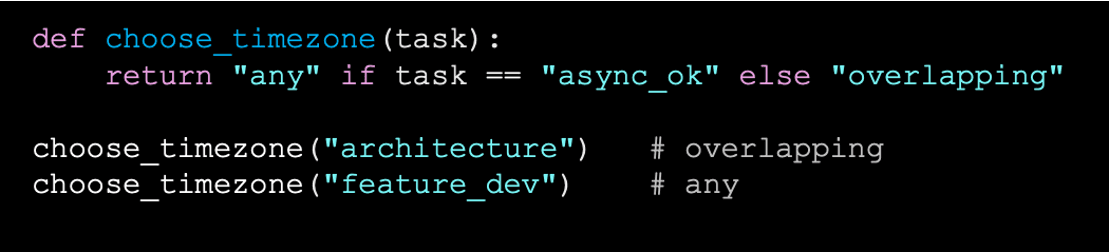
Some work thrives async (stable feature dev, infrastructure, well-defined QA). Some work dies without real-time collaboration (early product decisions, architecture, incident response).
Forcing everything into "fully remote" or "fully synchronous" breaks things.
Start with these questions:
• What decisions need to be made, and how often?
• Where does accountability actually sit?
• What can be handed over cleanly, and what can't?
Then design roles, overlap, and location around that, not around cost or convenience.
Most teams end up with something mixed:
• Core decision-makers closer to the business
• Execution roles are distributed where it makes sense
• Clear rules for handovers, escalations, and when real-time matters
You don't need a "remote work strategy." You need a work strategy that accounts for distribution.
That's exactly what we help teams figure out at i4ce.uk. We don't start with "how many devs do you need?" We start with:
• What's the actual work?
• Where are the gaps?
• What collaboration patterns does this require?
Only then do we talk about headcount, locations, and team setup.
If your remote team is slowing down, the answer probably isn't "less remote." It's clearer roles, better handovers, and collaboration designed for the work you're actually doing. Worth a conversation if you're scaling and things feel messy.