
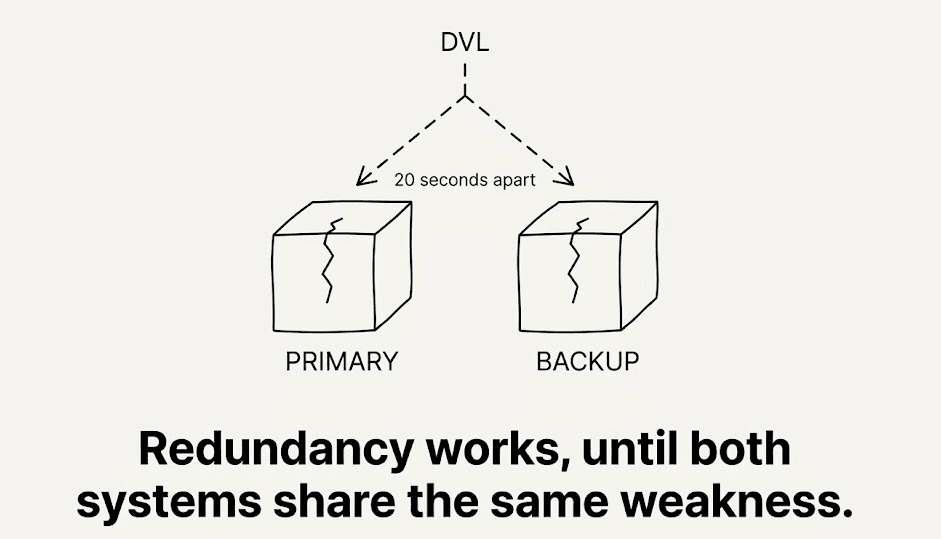
What happens if the backup shares the same blind spot as the system it's meant to protect.
Over 1,750 UK flights were cancelled yesterday. The total has passed 1,900 as disruption continues into today. The cause: a technical fault in NATS's flight-processing system, the organisation that manages air traffic across UK airspace. NATS hasn't disclosed the cause yet, and an investigation is underway, so I won't speculate on the specifics. But it brought to mind a similar failure in 2023 that is fully documented, and worth telling as a story on its own.
That failure started with something almost absurdly small. A flight plan from Los Angeles to Paris passed through two navigation beacons that happened to share the same three-letter code - one in North Dakota, one in Normandy. The system resolved the route using the wrong one, hit a critical exception, and shut itself down rather than pass possibly corrupt flight data through to controllers.
What happened next is the part that stays with me. The backup system, sitting there specifically to catch this kind of failure, received the exact same flight plan and hit the same critical exception. It broke in the exact same way, about twenty seconds later. Two systems, built to protect each other, turned out to be running the same assumptions underneath - so the one input that could beat one of them could beat both.
Over 700,000 passengers were affected. And the more I sit with it, the less this reads like a bug in the code and the more it reads like a gap somewhere upstream, in how "redundancy" got defined - as two of the same thing, rather than two genuinely different ways of catching a mistake.
I think about this a lot in the hiring work I do. Anyone can check whether an engineer has built a failover system before. It's much harder to tell whether someone actually thinks that way instinctively - whether they'd have asked, unprompted, what happens if the backup shares the same blind spot as the system it's meant to protect. That question rarely shows up on a CV. But it's usually the difference between a fix that closes one door and a fix that questions why the house had that many doors that all led to the same room.
Sources: CAA CAP2993 final report on the 2023 NATS failure (caa.co.uk/CAP2993); NATS official statement, 8 Sept 2026 (nats.aero)