
p-bits can be cheap and fast. So why do we still need qubits?
p-bits can be cheap and fast. So why do we still need qubits?
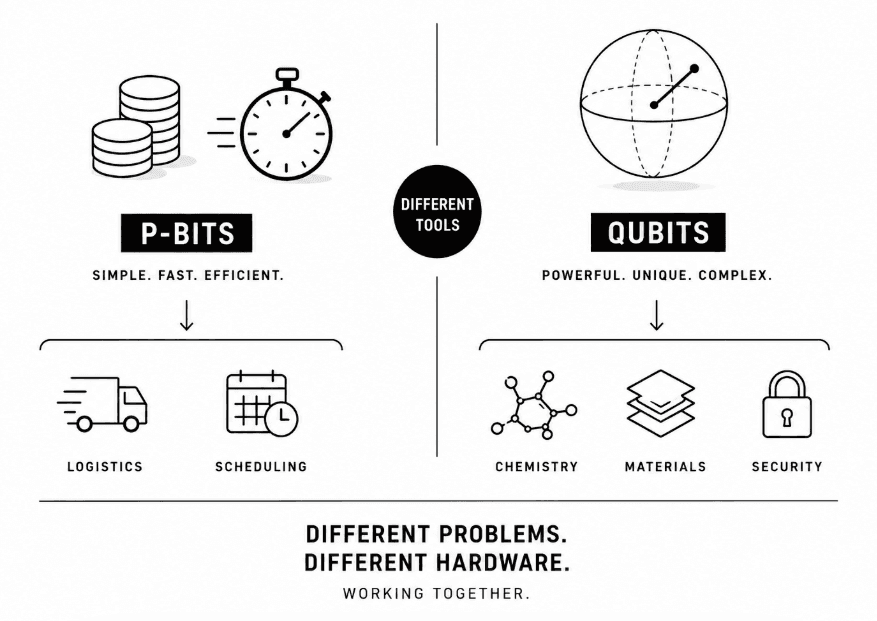
Following up on my spintronics post: several people asked a fair question. If p-bits are potentially simpler, can operate at room temperature, and are designed for fast probabilistic computing, why bother with quantum computers at all?
The short answer: p-bits and qubits do fundamentally different things.
P-bits are classical stochastic devices. They can flip randomly between 0 and 1 and, when connected together, can be useful for optimisation, sampling and inference problems. But they don't reproduce the uniquely quantum effects that give quantum computers their potential advantage.
Here are three important differences.
1. Quantum interference
Think of noise-cancelling headphones. They generate a wave that can interfere destructively with unwanted sound. Quantum algorithms can do something conceptually similar with probability amplitudes: some computational paths can interfere destructively, while others interfere constructively. That can suppress some outcomes and amplify others.
A p-bit can generate randomness and explore possibilities, but it doesn't have quantum amplitudes or quantum interference.
2. Entanglement
50 p-bits can be thought of as 50 coins connected by a classical network.
50 entangled qubits are different. Their joint quantum state cannot, in general, be decomposed into separate states for each qubit. That doesn't mean you can simply read out thousands or millions of answers at once. You still get a classical measurement. The important point is that the quantum state evolves as one system, with interference and entanglement available as computational resources.
3. Simulating quantum nature
This is where the distinction becomes particularly interesting. Molecules and materials obey quantum mechanics. Classical computers can simulate them, but some quantum systems become extremely difficult to model as they grow in complexity.
A quantum computer can encode and evolve a quantum system using the same underlying quantum mechanics, potentially avoiding some of the exponential overhead that makes classical simulation difficult.
That's why quantum simulation remains one of the major target applications for quantum computing - particularly in chemistry and materials science.
So what is this actually about?
Not p-bits versus qubits.
It's about using different hardware for different computational problems.
The more interesting future may be classical + probabilistic + quantum computing working together, rather than one replacing the others.
Different physics. Different strengths. Different jobs.
Sources: NIST, 130-nm CMOS-Integrated Superparamagnetic Tunnel Junction-Based p-bit (2026) · Nature Physics, Programmable simulations of molecules and materials with reconfigurable quantum processors (2025) · Aadit et al., Programmable Probabilistic Computer with 1,000,000 p-bits (arXiv, 2026).