
Freezing light and sound: the breakthrough that bridges two computing worlds.
Remember the old spy-movie trick of pressing a glass to a wall to hear what's happening on the other side? What if that just got 1,000x more powerful - and could one day fit inside a computer chip?
What happened
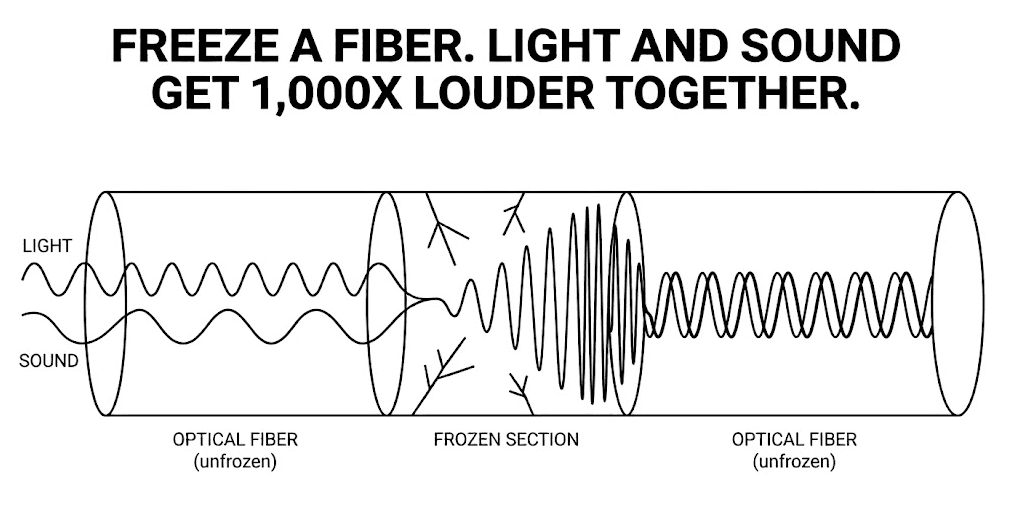
Researchers at the Max Planck Institute for the Science of Light took a liquid-core optical fiber, one with liquid at its core, and froze that liquid solid. Once frozen, light and sound started interacting with each other more than 1,000 times more strongly than in an ordinary fiber. They used that effect to build something called an optoacoustic memory, a way of storing information using light and sound together, in the same tiny space.
Why it matters
Light and sound don't naturally "talk" to each other very well. Most fiber optic cables are built to carry light and largely ignore sound. What this frozen fiber does is create much stronger coupling between the two simply by changing the physical state of the material inside it - from liquid to solid.
That matters because I've written about acoustic computing and photonic computing separately - two different physical approaches, explored mostly on their own. This is a striking example of the two actually meeting on the same physical platform, with the frozen fiber producing exceptionally strong light–sound coupling.
Now, let me imagine forward - this is speculation, not a demonstrated product:
If this effect holds up outside a lab, it hints at a new category of device altogether - one that could potentially store or process information through tightly coupled light and sound, in the same physical component, instead of treating them as two completely separate technologies. The researchers themselves point to neuromorphic computing and quantum information processing as areas this could feed into, alongside more precise sensing.
Worth being honest: this is one experimental result, using a specially frozen material, not a working chip or product. Going from a striking effect in a lab to something manufacturable is a long road.
The interesting part is that the next step in computing hardware doesn't always have to involve inventing a completely new material. Sometimes it's about taking an existing one and changing its physical state.
Sources: Seiderer, S. et al., "Giant Brillouin gain in frozen CS2 capillaries," Optica 13, 1415–1422 (2026), DOI 10.1364/OPTICA.600056 · Max Planck Institute for the Science of Light.