Five very different approaches to quantum computing.
This week, the US government put up to $500 million behind five very different approaches to quantum computing. Not one winner. Five, at once.
The background
Nobody yet knows which approach will ultimately scale to useful, fault-tolerant quantum computing. So the US Department of Commerce is spreading its bet across five very different technologies through the CHIPS Act. Four awards were finalised this week, up to $100 million each. A fifth is still pending final approval.
Meet the five contenders
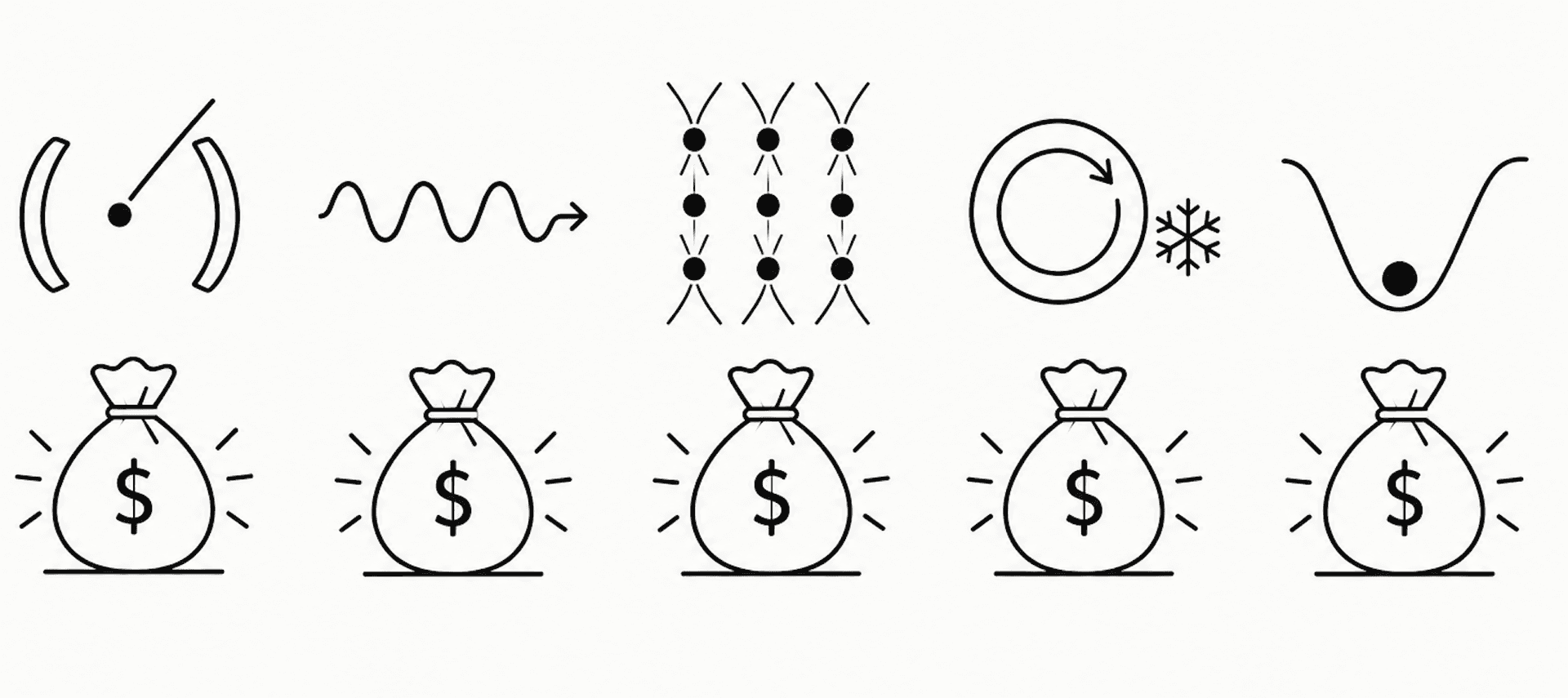
Quantinuum builds on trapped ions: single charged atoms held in place with electromagnetic fields, then precisely controlled with lasers. Think of holding a marble still with an invisible force, then nudging it exactly where you want with a beam of light. Helios has 98 fully connected qubits and reported gate fidelities above 99.9%.
PsiQuantum is staking its approach on photons, using light itself to carry information rather than holding it still. Picture the computer's memory as the beam of light in motion, not a container holding something in place. Its long-term target is roughly one million physical qubits, ambitious, not demonstrated today.
Infleqtion is building with neutral atoms, individual atoms with no electric charge, held in a precise pattern by crisscrossing beams of light, like grains of sand suspended in mid-air. It's under contract to install a full system at the Illinois Quantum & Microelectronics Park in 2027.
Rigetti Computing puts its money on superconducting circuits, cooled close to absolute zero, so cold that electrical resistance disappears, like a wheel spinning forever with no friction to slow it down. Speed is one of the technology's main advantages. Rigetti has deployed a 108-qubit system.
D-Wave takes a different route entirely. Instead of running precise step-by-step calculations, its machines let a system settle naturally into its most stable state, like water finding the lowest point in a landscape, a natural fit for optimisation problems. It's the most commercially established of the five, with over 100 customers in the first half of 2026.
Why fund all five?
Because each makes a different trade-off, trapped ions offer exceptional control but are relatively slow. Superconducting circuits are fast but need extreme cooling. Photons suit networking and scaling, but rarely interact with each other. Neutral atoms are promising but less proven. D-Wave is pursuing a genuinely different model of computation altogether.
The US government is effectively buying exposure to several possible futures rather than predicting the winner today. It's a wager that the answer is worth finding, and that a stake in several possibilities beats betting everything on one.
Sources: US Department of Commerce / NIST CHIPS for America · company announcements, September 2026.