Vibe Coding vs Agentic Engineering
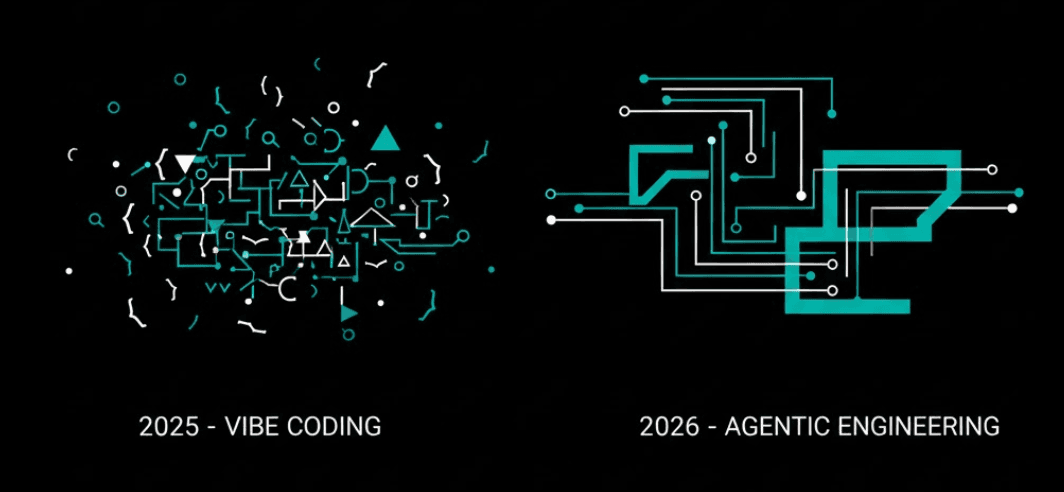
February 2025:
Describe a feature to AI, go for coffee, come back to ~1,800 lines of code.
Minimal review.
Side projects.
Ship and hope.
Andrej Karpathy called this vibe coding, and it captured a moment in software engineering perfectly.
Fun.
Chaotic.
“Almost works.”
Fast forward to 2026.
Describe a feature to an AI agent, come back to working code again, but the workflow has changed:
Review every change.
Run quality checks.
Test edge cases.
Ask the agent to refine the implementation.
Same speed.
More discipline.
Karpathy recently described this evolution as agentic engineering, engineers orchestrating AI agents that implement software while humans provide oversight and system design.
You can already see this in real workflows:
• generating integration tests across services
• refactoring legacy codebases safely
• implementing product features from specs
• migrating systems with agent assistance
If vibe coding was the experiment, agentic engineering looks like the production version.
Engineering value is moving from typing code to designing systems and validating outcomes.
At iForce Connect, this shift is already shaping how engineering hiring is approached, focusing less on coding speed and more on architectural thinking, problem-solving, and the ability to work effectively with AI-driven workflows.