
Trapped ions
Trapped ions: the quantum computing technology behind Quantinuum and IonQ
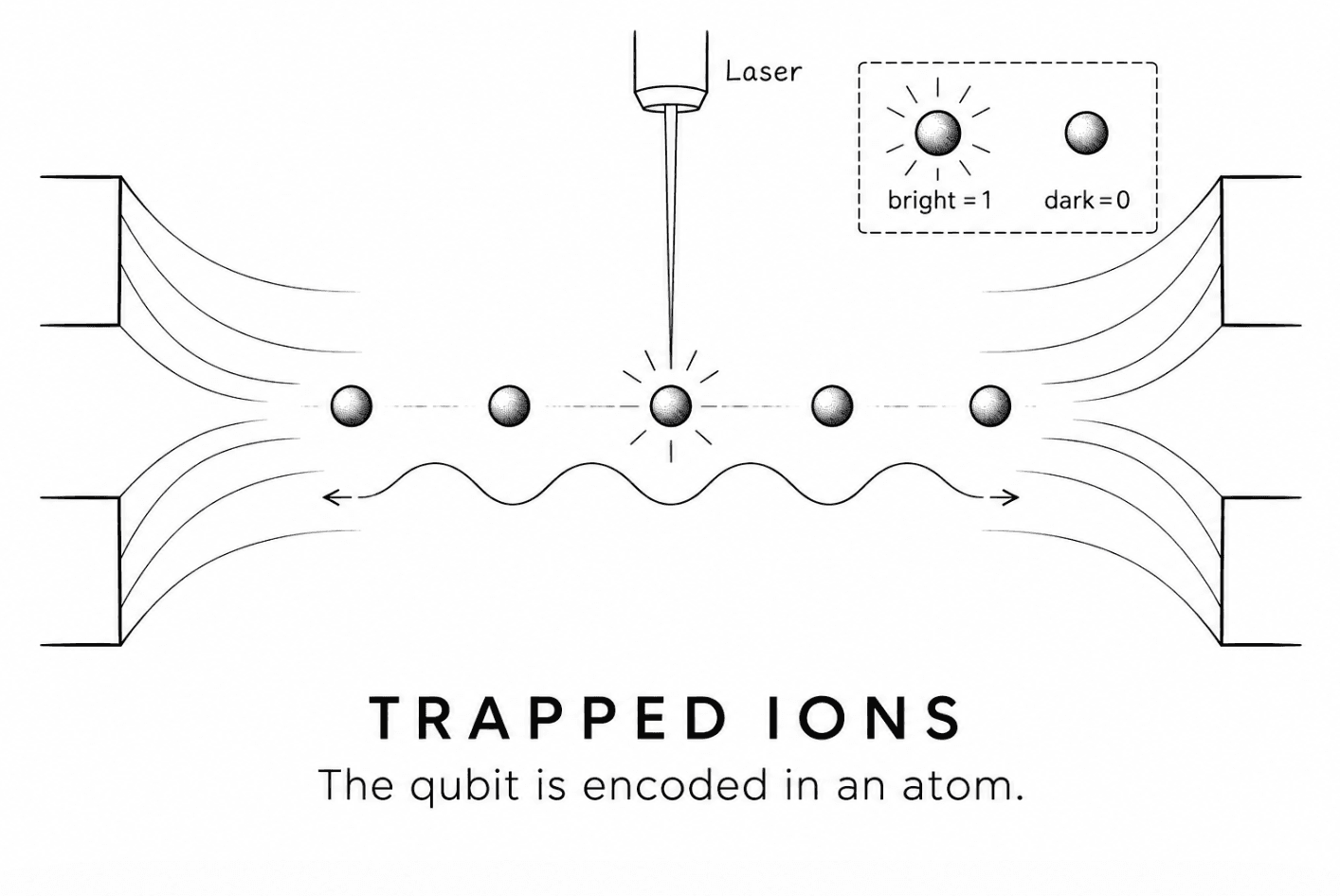
Individual charged atoms, ions, are held in place in a vacuum by electromagnetic fields, then precisely controlled using lasers or, increasingly, integrated electronics. Unlike superconducting circuits, the qubit here is a real atom rather than something fabricated.
A simple way to picture it
Think of holding a marble perfectly still using an invisible force field, then nudging it exactly where you want with a beam of light. Each atom naturally has quantum properties built in; engineers don't build the qubit from scratch; they just trap and control one that already exists in nature.
How a calculation actually happens
Ions are held in a device called a Paul trap, using oscillating electric fields to keep them suspended in a line, like beads on an invisible string. In laser-controlled systems, lasers flip an ion's state and nudge the shared vibration of the chain to entangle two atoms, even though they aren't touching. At the end, another laser reads each ion's state, bright for one value, dark for the other, giving a classical 0 or 1.
Where the technology stands today
Trapped ions are among the industry leaders in gate fidelity. IonQ reported a world-record two-qubit gate fidelity above 99.99% in October 2025, roughly one error per ten thousand operations. Quantinuum's Helios runs 98 physical barium-ion qubits and has demonstrated 48 error-corrected logical qubits, showing how high fidelity can help reduce error-correction overhead. Trapped ions also hold quantum information far longer than their operation times, part of why the architecture remains a leading candidate for fault tolerance.
Its biggest advantage: precision and connectivity
Ions can interact through shared vibrations or be physically shuttled within the trap, letting qubits interact beyond immediate neighbours. Combined with high gate fidelities, this can help cut the error-correction overhead needed for reliable logical qubits.
The trade-off
That precision costs speed. Controlling individual atoms is slower than flipping a superconducting circuit with a microwave pulse, and scaling to large ion counts while keeping every atom precisely controlled remains a real engineering challenge.
Commercially, where this sits
IonQ reported $130 million in 2025 revenue, the first public quantum company past $100 million annually, with systems on AWS, Azure, and Google Cloud. Its newly announced Superion 256 uses chip-integrated electronic control for trapped-ion qubits. Quantinuum's IPO closed in June 2026, raising $1.68 billion; it now trades on Nasdaq as QNT.
Trapped ions may not lead in raw qubit count, but remain a top contender in fidelity, connectivity, and progress toward fault-tolerant logical qubits.
Sources: IonQ; Quantinuum; IonQ/Oxford Ionics technical publications.