
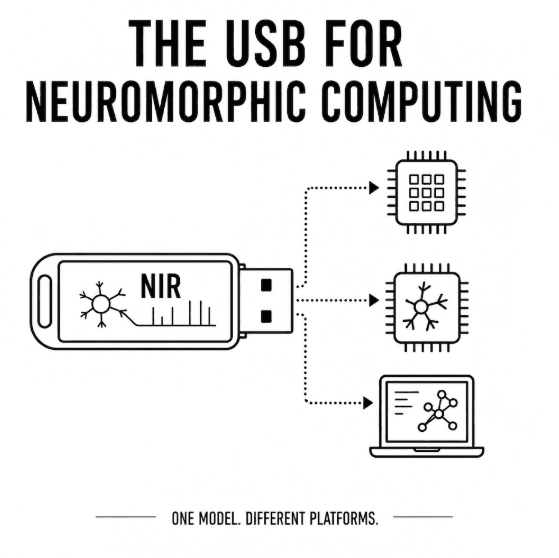
The USB, for brain-inspired computers.
The USB, for brain-inspired computers.
That's a useful way to think about NIR, short for Neuromorphic Intermediate Representation. It's a quiet software layer addressing one of neuromorphic computing's biggest problems: none of these chips can speak the same language.
What it is
Neuromorphic systems process information event by event, rather than continuously computing like a conventional processor. That event-driven approach is a big part of where their efficiency comes from.
The catch: once a model is trained - meaning the finished, working version of a neural network after it's learned from data - moving it between different neuromorphic platforms can require platform-specific conversion, tooling and optimisation. And "different chip" doesn't just mean a different company. It often means genuinely different underlying technology: digital cores simulating neurons in software, versus purpose-built spiking silicon. Moving to a different one can require significant rework.
NIR addresses this. It's a shared, open intermediate representation for exchanging neuromorphic models. A trained model can be represented once, then loaded into a different simulator or translated for different hardware platforms - similar to how USB provides a common interface across devices from different companies, instead of requiring a different interface for every device.
Where it's used
SynSense, a Swiss-Chinese company, is a good real-world example. Their Speck and Xylo platforms are among the hardware platforms supported by NIR, with Speck having reached commercial production and SynSense working with industrial partners. Models for these platforms can be trained and moved using NIR-connected tools.
Why it matters
Hardware alone doesn't decide whether a computing shift succeeds - the invisible software layer over it does. Neuromorphic computing already has several genuinely different physical approaches racing at once. Without something tying them together, each risks becoming its own isolated dead end, with real engineering effort spent rebuilding or adapting the same model for every chip, instead of the field actually scaling.
Worth noting from a talent lens: NIR is fully open source, a real way to get hands-on with neuromorphic software directly, not just read about the chips.
What's next
NIR helps with moving a model between tools, but a June 2026 research paper makes the limitation explicit: it describes a network, but doesn't by itself make that network run efficiently on hardware. That paper introduces a new compiler layer, built specifically to pick up where NIR leaves off. A sign the standard is maturing, not finished.
Sources: Pedersen, J.E. et al., "Neuromorphic intermediate representation: A unified instruction set for interoperable brain-inspired computing," Nature Communications (2024) · neuroir.org · Garcia Gener, A. et al., "SNN-MLIR: An MLIR Dialect for Compiling Neuromorphic SNNs" (2026).