
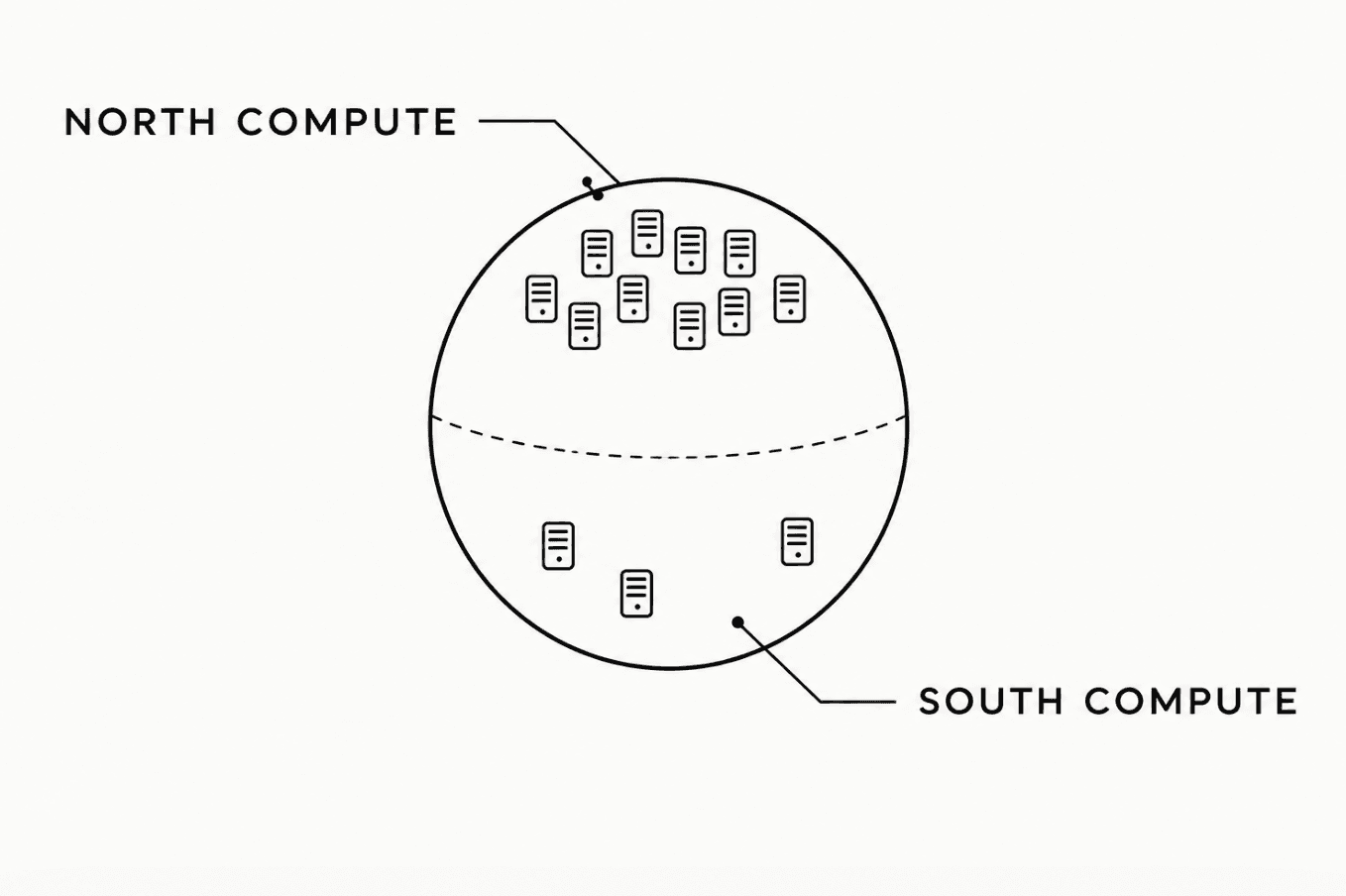
The AI and quantum talent pipeline begins with compute access, not hiring.
A growing body of research points to the same emerging fault line across advanced computing: access, not just talent or ideas, increasingly shapes who gets to participate. The International AI Safety Report notes that access to computing resources like GPUs and data centers has become deeply unequal between large AI companies and academic labs, and that gap has been widening in recent years.
The numbers behind it.
Stanford's 2026 AI Index found the US alone hosts more than 5,000 data centers, over ten times as many as any other single country.
Researchers have begun describing this geography as "Compute North" and "Compute South": a world in which countries differ sharply in their access to compute for developing versus deploying AI.
Quantum computing may be heading toward a similar divide. Peer-reviewed research on national quantum strategy points to quantum echoing earlier digital revolutions like AI, and frames broadening access as a real opportunity to avoid repeating the same inequalities, rather than something governments should assume will resolve on its own.
Talent concentration appears to follow a similar geography. Top AI research and expertise remain concentrated in a relatively small number of countries, many of which also have the greatest access to compute. Within those countries, the imbalance shows up again between industry and academia, with large labs holding far greater access to cutting-edge computing resources than universities.
A competitiveness question, not only a fairness one.
As AI and quantum workloads increasingly run on cloud infrastructure rather than local systems, concentrated compute access can also mean concentrated dependency. Countries and organizations that remain primarily consumers of these tools risk having less ability to shape how the technology develops around their own needs.
The uncomfortable parallel.
This mirrors what I've written about quantum computing's talent gap specifically, just one level earlier. A hiring problem downstream starts as an access problem upstream. Different technologies, same underlying resource problem: who has access to the compute needed to build with them. If that access keeps concentrating among a small number of well-resourced players, the pipeline of people who even get early exposure to these fields narrows too.
There are efforts pushing back: national compute initiatives in the US, UK, EU, and elsewhere aim to widen access for academic and public researchers. Worth watching whether they move fast enough to keep the talent pipeline as open as the technology itself is advancing.
Sources: International AI Safety Report (2026); Stanford HAI, AI Index Report 2026; IEEE Spectrum, "When AI Literacy Becomes the New Fault Line" (2026); Transforming Government: People, Process and Policy (2025/2026).