
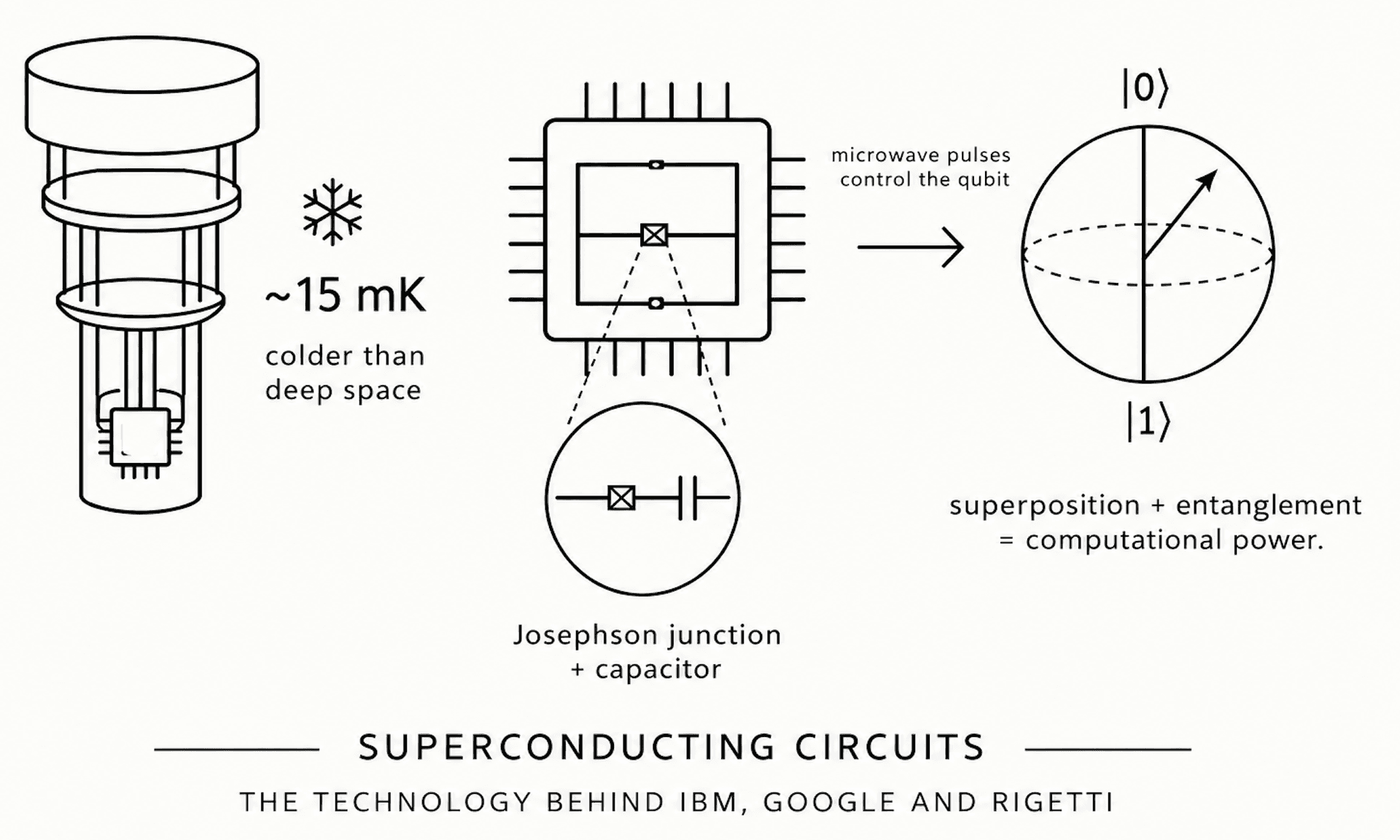
Superconducting circuits
Superconducting circuits: the quantum computing technology behind IBM, Google, and Rigetti Computing
Tiny superconducting circuits, cooled to about 15 millikelvin, colder than deep space. At that temperature, electrical resistance disappears, and the extreme cold suppresses the thermal noise that would otherwise destroy a qubit's fragile quantum state.
A simple way to picture it
Think of a spinning wheel with zero friction: once set moving, it just keeps going. The difference here is that the circuit can occupy a controlled combination of quantum states, which is what gives the qubit its computational power.
How a calculation actually happens
The qubit is built around a tiny insulating barrier called a Josephson junction, paired with other circuit elements like a capacitor, together creating quantised energy levels that act as the qubit. Precise microwave pulses can flip the qubit's state, put it into superposition, or link it to a neighbouring qubit. A final pulse reads the result, producing a classical 0 or 1.
Where the technology stands today
This is one of the most mature approaches in quantum computing. IBM's Heron processor has 156 qubits, with Heron r3 reporting median two-qubit gate fidelity of about 99.9%. Google's Willow chip demonstrated below-threshold error correction, as the error-correcting code got larger, the logical error rate fell, a major step toward fault tolerance. Rigetti's Cepheus-1 reached general availability in April 2026, with 108 qubits and 99.1% median two-qubit gate fidelity.
Its biggest advantage: speed and manufacturing
Superconducting gates execute in nanoseconds, far faster than many competing approaches. These chips are fabricated using established semiconductor-style processes, including lithography, thin-film deposition and cleanroom fabrication, letting this approach lean on an established manufacturing ecosystem rather than building a new one from scratch.
The trade-off
The qubits are fragile and short-lived, and every chip needs a dilution refrigerator just to operate. Scaling from hundreds of qubits to the numbers needed for useful fault tolerance remains a major engineering challenge.
Commercially, where this actually sits
Still largely an R&D market: some buy hardware, while others access processors through the cloud. Rigetti sold a physical processor to the University of Saskatchewan in March 2026; India's C-DAC placed an $8.4 million order for a 108-qubit system. IBM, Google, and Rigetti are among the best-known superconducting quantum computing programmes, alongside IQM, which went public in 2026.
Sources: IBM Quantum; Google Quantum AI; Rigetti Computing; NIST; IQM.