
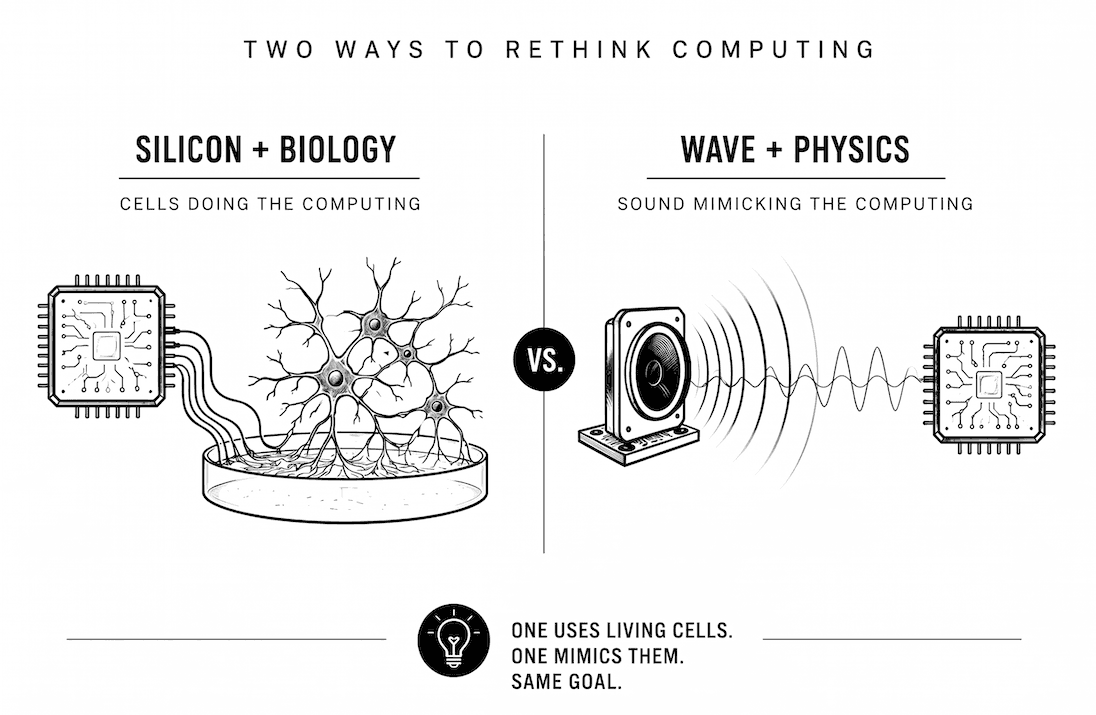
Silicon + Biology, or Wave + Biology?
Comparing Two Ways to Rethink Computing. After my last post, a good discussion came up around whether sound- and wave-based approaches deserve equal billing alongside living-cell computing.
Both are real research directions, tackling the same problem from different angles. Worth laying them out side by side.
The shared problem
Silicon computing is running into physical limits: transistors are approaching atomic scales, while the power and cooling demands of large-scale computing continue to grow. Both approaches below are attempts to rethink how computation happens, using different physics.
Silicon + biology: cells doing the computing
Living human neurons, grown in a lab, wired to a chip. Cortical Labs' CL1 sends electrical signals into roughly 800,000 real neurons and reads their responses. FinalSpark offers a related approach as a cloud service, using brain organoids instead.
The bet: biological neurons already do adaptive, low-power processing extremely well, so let real tissue handle some of the work instead of simulating it in software. Both platforms are commercially accessible today. The main challenge is keeping living cell cultures alive and stable over time.
Wave + biology: sound doing the computing
Here, "biology" means the inspiration, not the material.
Instead of living cells, this approach uses sound or light waves themselves to perform calculations before the information is converted into conventional digital form.
A clear example: University of Arizona researchers built an "acoustic synapse," a chip that processes information using sound waves, inspired by how biological synapses process signals.
In classification tests, it converged 20% faster and used at least an order of magnitude less power than the electrical devices used for comparison. The work was peer-reviewed and published in Science Advances.
This is still lab-stage - no commercial product yet. The core appeal is that waves can interact and interfere with each other, allowing some computation to happen directly in the physical system rather than through conventional electronic processing.
Why I don't think it's either/or
It's tempting to frame this as one approach eventually winning out over the other. I don't think that holds up.
One is about processing that adapts and learns; the other is about exploiting physical wave interactions for fast, parallel processing. A future system could plausibly use both, alongside silicon, for the parts each does best.
What's interesting is that both point to the same conclusion from opposite directions: the next real gains in computing may not come only from making transistors smaller, but from computing in physical media - biological or otherwise - that were never designed for it in the first place.
References
Chen, J. et al., "Topological acoustic synapse for high-dimensional neuromorphic computing," Science Advances, 2026