
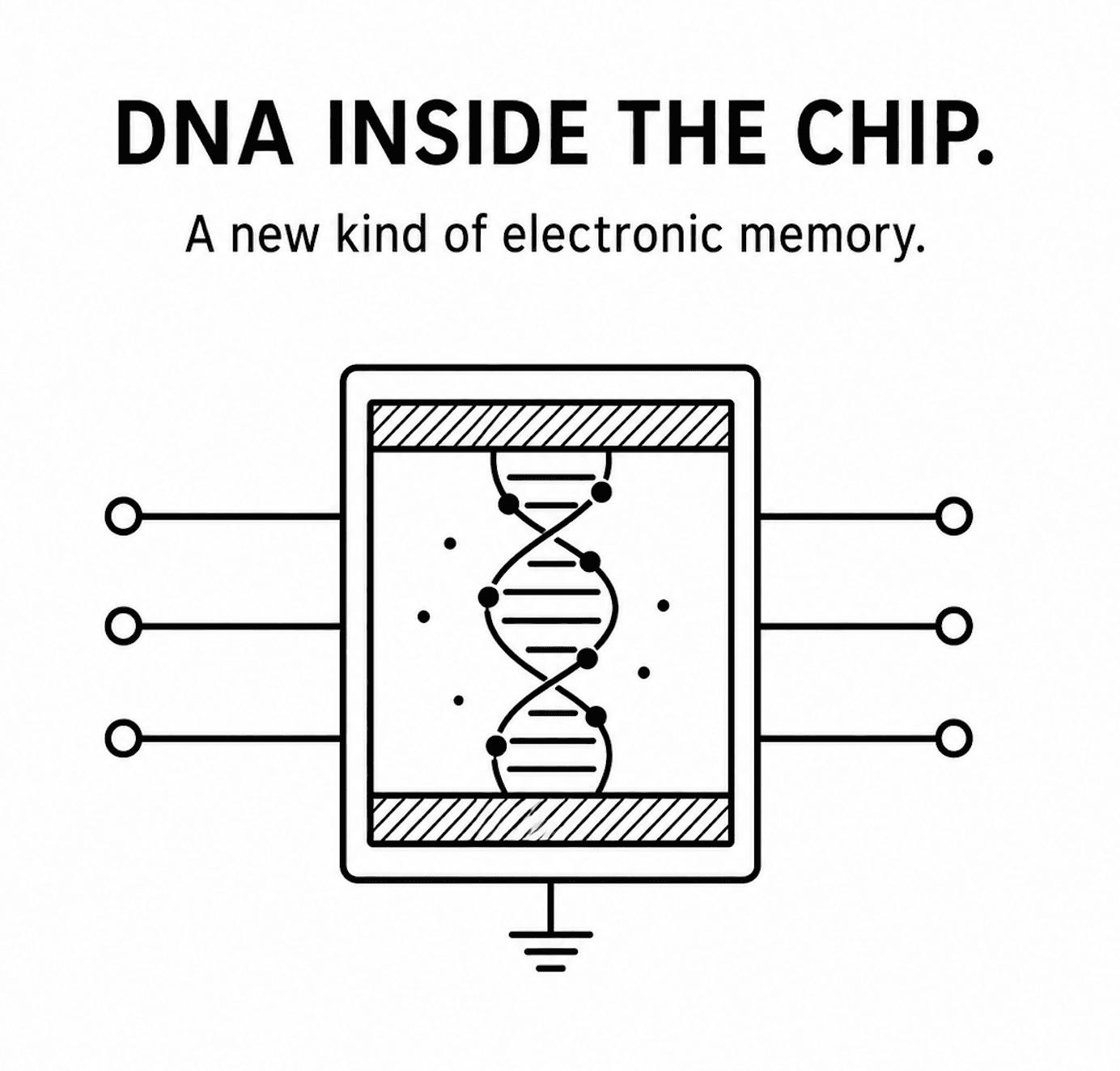
Researchers built DNA directly into an electronic memory device.
I've written about DNA data storage before: astonishingly dense, durable for centuries, needing zero power once written. The catch has always been speed - writing and reading DNA is far slower than electronic storage, fine for an archive, harder for anything active. This new result takes DNA somewhere different: instead of just storing information, researchers built DNA directly into an electronic memory device.
DNA storage already exists commercially - Biomemory sells a DNA storage card today. DNA computing itself isn't new either. What's new here: putting DNA inside an electronic component.
How it actually works, put simply
Researchers at Penn State University built a memristor, a component whose resistance changes based on its electrical history and stays changed even after power is switched off, more like a dimmer switch that remembers where you left it than a normal switch that resets.
To build one, they used synthetic DNA - real DNA chemistry, engineered in a lab rather than taken from a living thing - and added silver nanoparticles to it, similar to weaving metal wire through fabric so it can conduct electricity while keeping its shape. That silver-laced DNA was paired with a semiconductor called perovskite, already used in solar cells and lasers, to build a working circuit.
Is this neuromorphic computing? Not quite. A memristor is a building block. Neuromorphic computing is the broader design that combines memory and processing this way. The researchers describe this device as a promising platform.
What the numbers mean
Penn State reports the device uses about 100 times less power than something like a flash drive. Their own framing, not a controlled side-by-side test. It ran on very low voltage, held up under heat, and kept working for over six weeks at room temperature. A separate, more technical comparison in the paper itself, against other lab-based memristors, showed an even bigger efficiency gap, though that's a lab-to-lab comparison, not a real-world benchmark.
Hasn't this been tried before?
Yes, and it kept failing for a clear reason. Scientists have tried combining DNA with electronics since the 1990s, but natural DNA is long and tangled, like wet spaghetti, hard to position precisely on a chip. The fix was using synthetic DNA specifically, short, engineered sequences that can actually be arranged with precision.
Where this could go
This work sits on a different track from DNA archiving - electronic memory with potential in computing and neuromorphic hardware, still far from commercial. It's one published result and a filed patent, a new materials platform to build on.
Sources: Keremane, K.S. et al., Advanced Functional Materials (2026) · Penn State News.