
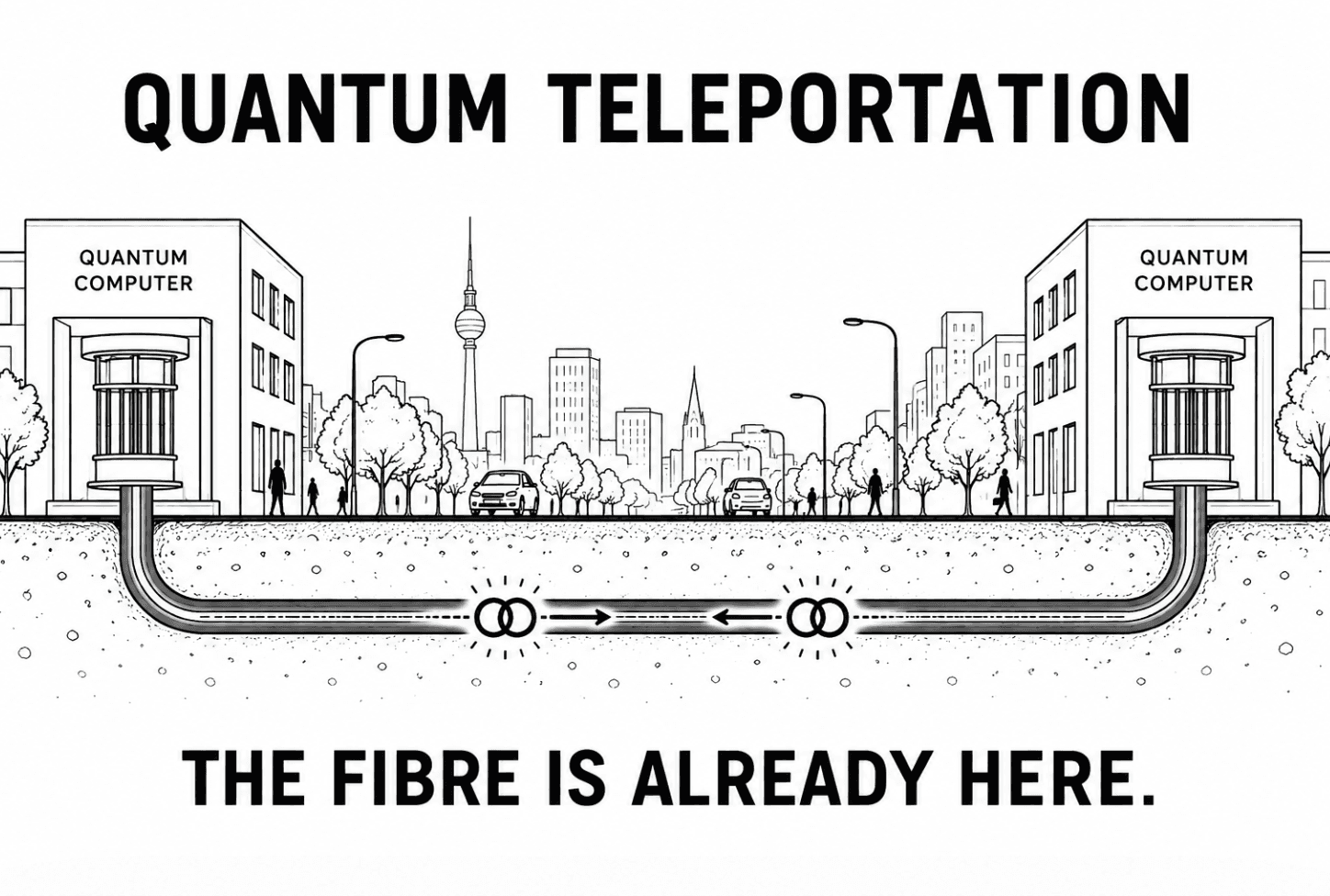
Quantum teleportation
Quantum teleportation is moving onto the internet infrastructure we already have.
Here's the problem. Every signal in a normal internet cable weakens with distance. Networks fix this by amplifying and repeating it along the way. Solved decades ago. Quantum information can't be fixed the same way: an unknown state can't be perfectly copied, and measuring it generally disturbs it. Sending it over real distance needs a different trick: quantum teleportation.
What is quantum teleportation, actually? Not beaming a person across a room. The original particle isn't transported. It transfers quantum information - the quantum state of a particle - from one location to another, using a pre-shared entangled pair plus an ordinary signal sent the normal way. No faster-than-light communication, no rule of physics broken. Just information moved.
For years, one big question has been whether a real quantum network would need its own dedicated fibre, essentially a parallel network. Four experiments in 2026 suggest important parts of it could run on telecom infrastructure already in the ground.
February, Berlin: Deutsche Telekom and Qunnect teleported quantum states across 30 km of deployed commercial fibre, alongside ordinary classical traffic. Average fidelity: 90%, peaking at 95%.
July, Chicago: Northwestern University distributed entangled photons across 24.4 km of installed fibre while the same cable carried high-capacity conventional internet traffic. Fidelity held above 94%.
August, Maryland: NIST, UMD, and Qunnect distributed entanglement across 62 km of fibre, much of it above ground and exposed to wind, traffic, and temperature swings. Over a full 24-hour period, the system distributed entangled photons 92.8% of the time.
September, Osaka: researchers demonstrated a 10-channel photonic interface for neutral-atom quantum computers, coupling photons from 10 atoms into parallel fibre channels with negligible crosstalk, a step towards connecting multiple quantum processors.
Why this progression matters
Together, [quantum computer A → photonic interface → existing fibre → photonic interface → quantum computer B] is starting to take shape. We're nowhere near plug-and-play standards yet. But researchers are separately solving how quantum systems could talk to each other, over cable already in the ground.
As Deutsche Telekom's product lead put it: "Our fiber optic network is quantum ready."
Where this leads
The goal is a quantum internet: distributed quantum computing, quantum-secure communication, and networks of ultra-precise sensors and clocks. Still a long road ahead. But increasingly, some of the infrastructure needed may already exist.
Sources: Deutsche Telekom & Qunnect (Feb 2026); Northwestern University, Optica Quantum (Jul 2026); NIST/UMD/Qunnect, JOCN; University of Osaka/NICT/Hamamatsu Photonics, Optica.