
Quantum computers don't need to exist yet to already be a threat to sensitive data.
"Harvest now, decrypt later" describes a simple attack: someone copies encrypted data today, stores it, and waits for a computer powerful enough to unlock it later. No hacking required now, just patience - and security agencies already treat this as a present-day risk, not a future one.
Some recent estimates put cryptographically relevant quantum computers within the 2030s. That timeline has been shrinking fast, though - research published between May 2025 and March 2026 cut the estimated computing power needed to break RSA-2048 encryption by more than 20x, from roughly 20 million qubits down to under 1 million, with some newer approaches suggesting the number could fall as low as 100,000 physical qubits.
Messaging platforms have already responded. Signal introduced its PQXDH protocol, and Apple added similar quantum-resistant protection to iMessage through PQ3, both specifically built to defend against this threat and designed to operate transparently for users.
But a stronger algorithm only solves half the problem. A lock is only as strong as the randomness used to generate its key, and that layer gets far less attention. Most computers rely on algorithms to generate pseudorandom numbers, starting from a value called a "seed" and, in secure systems, high-quality entropy. If an attacker can predict or recover that seed or the underlying entropy, they may be able to reconstruct the supposedly random output rather than needing to guess it.
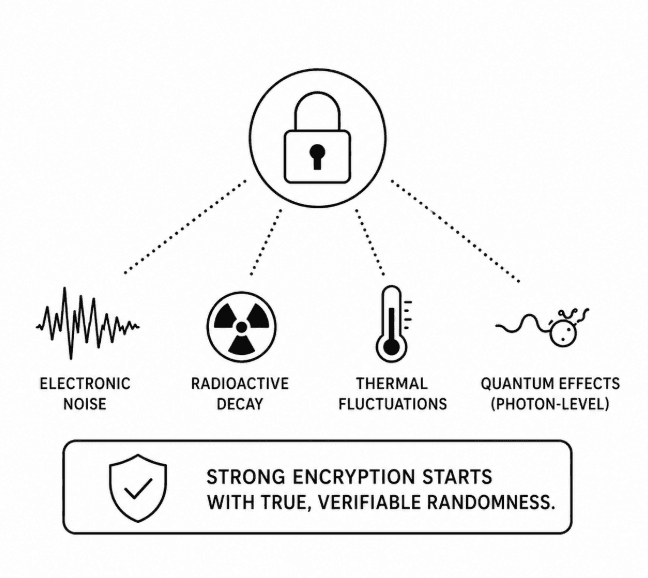
The alternative comes from the physical world rather than an algorithm - electronic noise, radioactive decay, thermal fluctuations inside a chip. That entropy source still needs to be measured, monitored and validated to confirm it's genuinely unpredictable.
Two separate questions follow for any organisation handling sensitive data: is the encryption itself quantum-ready, and is the randomness underneath it coming from something genuinely unpredictable and verifiable?
The second question has more than one answer. Some approaches pull randomness from physical noise inside conventional hardware; others draw it directly from quantum effects, such as vacuum fluctuations measured at the photon level. A recent academic survey mapped out this landscape, comparing these entropy sources against validation standards like NIST SP 800-90B, used to validate the entropy provided by their physical sources. Across these approaches, the entropy has to hold up under testing - increasingly something companies are expected to prove, not assume.
Sources: The Quantum Insider (2026); Signal PQXDH documentation; Apple iMessage PQ3; NIST Post-Quantum Cryptography Standards & SP 800-90B; ScienceDirect TRNG review (2026).