
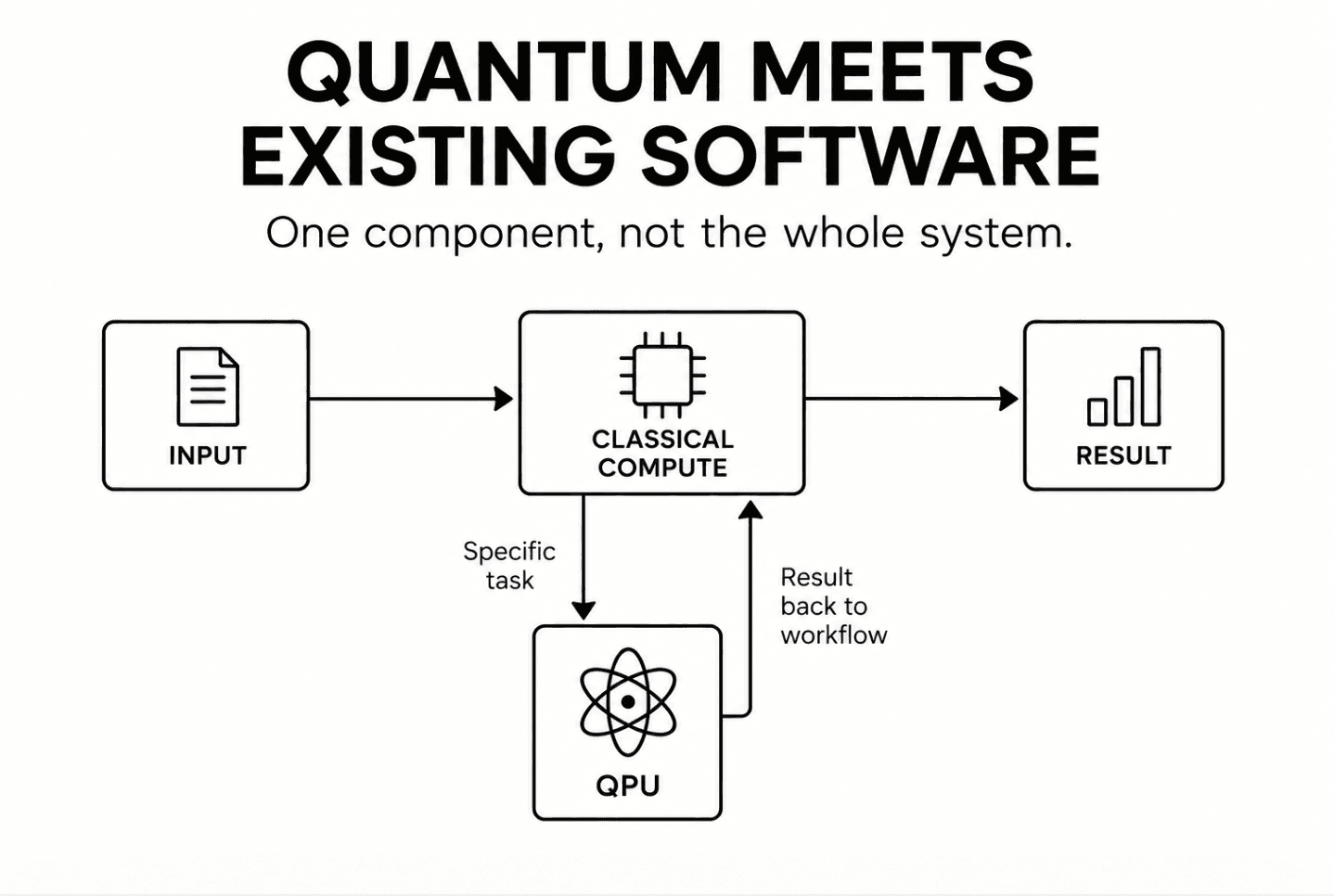
Quantum Meets Existing Software
Quantum is finding its place inside existing software. The pattern is getting hard to ignore. Take one specific piece of a calculation a classical computer was already doing, hand it to a quantum algorithm, and leave the rest of the workflow largely intact. Quantum becomes one more component inside a system that already exists.
Sept 2026 - engineering simulation: IonQ and Synopsys Inc integrated a quantum algorithm into one piece of a calculation inside LS-DYNA, an industry-standard engineering simulation tool, while the rest of the workflow stayed largely the same. In numerical experiments, total simulation time improved by up to 14.6%. Physical execution was separately validated on IonQ's 36-qubit Forte processor. The work won a 1st Place Best Paper Award at IEEE Quantum Week 2026.
Jul 2026 - railway scheduling: Deutsche Bahn and IQM Quantum Computers used real operational data covering 190 trips across five German cities. The larger scheduling problem was split into smaller pieces, with quantum solving selected subproblems and classical systems managing the rest. This one ran end to end on real quantum hardware and produced feasible schedules.
Jun 2026 - automotive aerodynamics: Nissan Motor Corporation and quantum software company Quemix Inc. built a hybrid algorithm for simulating airflow around a vehicle's shape, one of the harder problems in automotive engineering, matching the accuracy of the classical method already in use. Ran on a quantum simulator; real hardware execution is a future goal.
Apr 2026 - freight logistics: IonQ and freight company Einride connected Einride's vehicle routing solver to IonQ's quantum simulations, tested on real, anonymized shipment data. Quantum handled one optimization decision, filling gaps left by cancelled shipments, then handed the result to the classical solver to finish. In the best-performing instances: up to 12% more shipments delivered and up to 6% less drive distance per shipment, with cost effectively unchanged.
Different companies, different problems, same move: nobody rebuilt the system around quantum. It handled one specific part of a job classical computers already knew how to do. Similar patterns are emerging in drug discovery and materials science too. Worth its own post another time.
We're still early, and these are research demonstrations, not production deployments. But perhaps this is what practical quantum adoption looks like: not replacing the computing stack, but becoming part of it.
Sources: IonQ/Synopsys, IEEE Quantum Week (Sep 2026); Deutsche Bahn/IQM (Jul 2026); Quemix/Nissan (Jun 2026); IonQ/Einride (Apr 2026).