
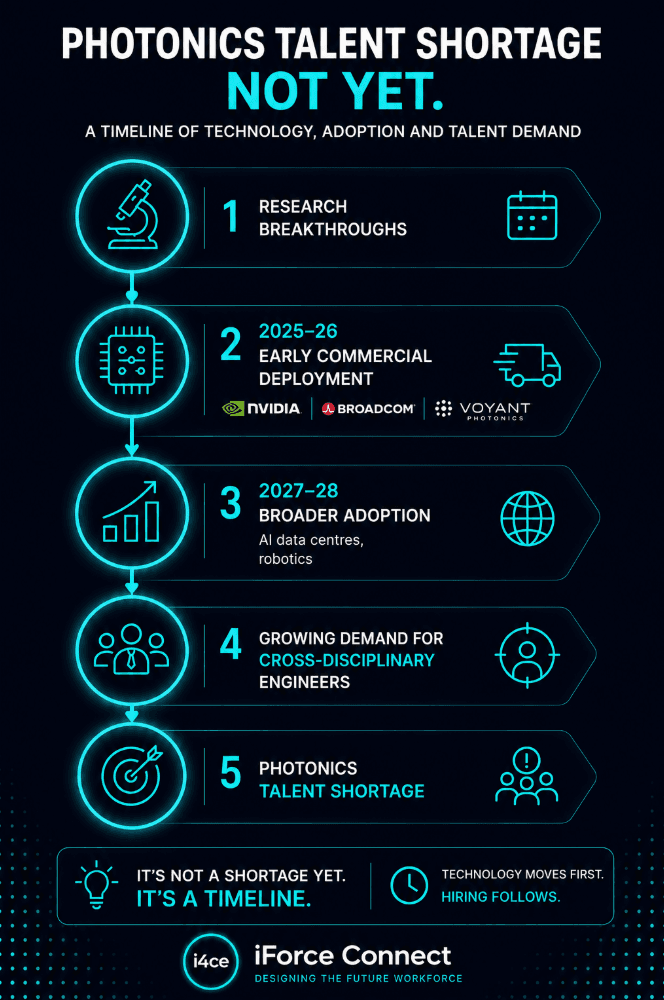
Photonics talent shortage - not yet.
A photonic engineer designs the systems that compute, sense, or communicate using light instead of electrons - working across optics, materials science, and chip design to build things like light-based processors, optical interconnects, and photonic quantum hardware. It's a hybrid role: part physicist, part semiconductor engineer, part systems designer. Right now the pool of people who can genuinely do this is small, mostly academic, and the industry still hasn't fully settled on a common job title.
𝘚𝘰 𝘩𝘰𝘸 𝘴𝘰𝘰𝘯 𝘸𝘪𝘭𝘭 𝘵𝘩𝘦𝘳𝘦 𝘢𝘤𝘵𝘶𝘢𝘭𝘭𝘺 𝘣𝘦 𝘢 𝘴𝘩𝘰𝘳𝘵𝘢𝘨𝘦 - 𝘢𝘯𝘥 𝘸𝘩𝘦𝘳𝘦 𝘢𝘳𝘦 𝘸𝘦 𝘳𝘪𝘨𝘩𝘵 𝘯𝘰𝘸?
Today, it's not really a shortage. It's a mismatch. There are plenty of optics engineers, and plenty of chip engineers. Almost nobody is both. The few who are command a significant premium, because a single bad chip build can cost six figures and months to fix.
What's changing the timeline is the pace at which the technology is moving from the lab into commercial products, not headcount. This spring alone: an algorithm designed a chip layout no human would have thought of, producing a photonic design roughly 500 times smaller than comparable human-designed devices. Researchers also demonstrated a single chip that can generate, steer, and detect light on one integrated device - something that used to take a room full of hand-aligned lasers. And some specialised photonic AI accelerators have now demonstrated nearly 300 times higher throughput than conventional silicon on specific inference workloads, while using a fraction of the power.
𝘞𝘩𝘦𝘳𝘦 𝘥𝘰𝘦𝘴 𝘵𝘩𝘪𝘴 𝘴𝘩𝘰𝘸 𝘶𝘱 𝘧𝘪𝘳𝘴𝘵? 𝘛𝘸𝘰 𝘦𝘹𝘢𝘮𝘱𝘭𝘦𝘴 - 𝘢𝘯𝘥 𝘳𝘰𝘶𝘨𝘩𝘭𝘺 𝘸𝘩𝘦𝘯.
Data centres: Many high-bandwidth links inside AI servers still rely on electrical interconnects, which consume significant power moving data. Replace more of those links with optics, and data moves faster using a fraction of the power. This isn't a "someday" - Nvidia and Broadcom already shipped early versions in 2025–26. Analysts expect optical interconnects to become increasingly mainstream in AI data centres around 2027–2028.
Robotics: Robots and drones used to rely on spinning LiDAR units to "see." That's shrinking onto a single chip - smaller, tougher, and lighter on battery. Integrated LiDAR chips are already shipping in commercial products today. Broader rollout across robotics and self-driving is expected over the next 2–3 years as prices keep falling.
And that gap is where the hiring pressure will land first, well before "photonics engineer" becomes a normal job title on LinkedIn.
Sources: Harvard SEAS & Max Planck Institute (Nature Communications, 2026) · Monash University (Nature Photonics, June 2026) · Tech Briefs Photonics, Optics & Imaging (June 2026) · 2026 Photonic Neuromorphic Computing Landscape report