
Photonic quantum computing
Photonic quantum computing: the technology behind PsiQuantum
Individual photons - particles of light - are used directly as qubits rather than atoms or artificial circuits, and unlike every other modality in this series, the qubit here travels through the system rather than being held in one place.
A simple way to picture it
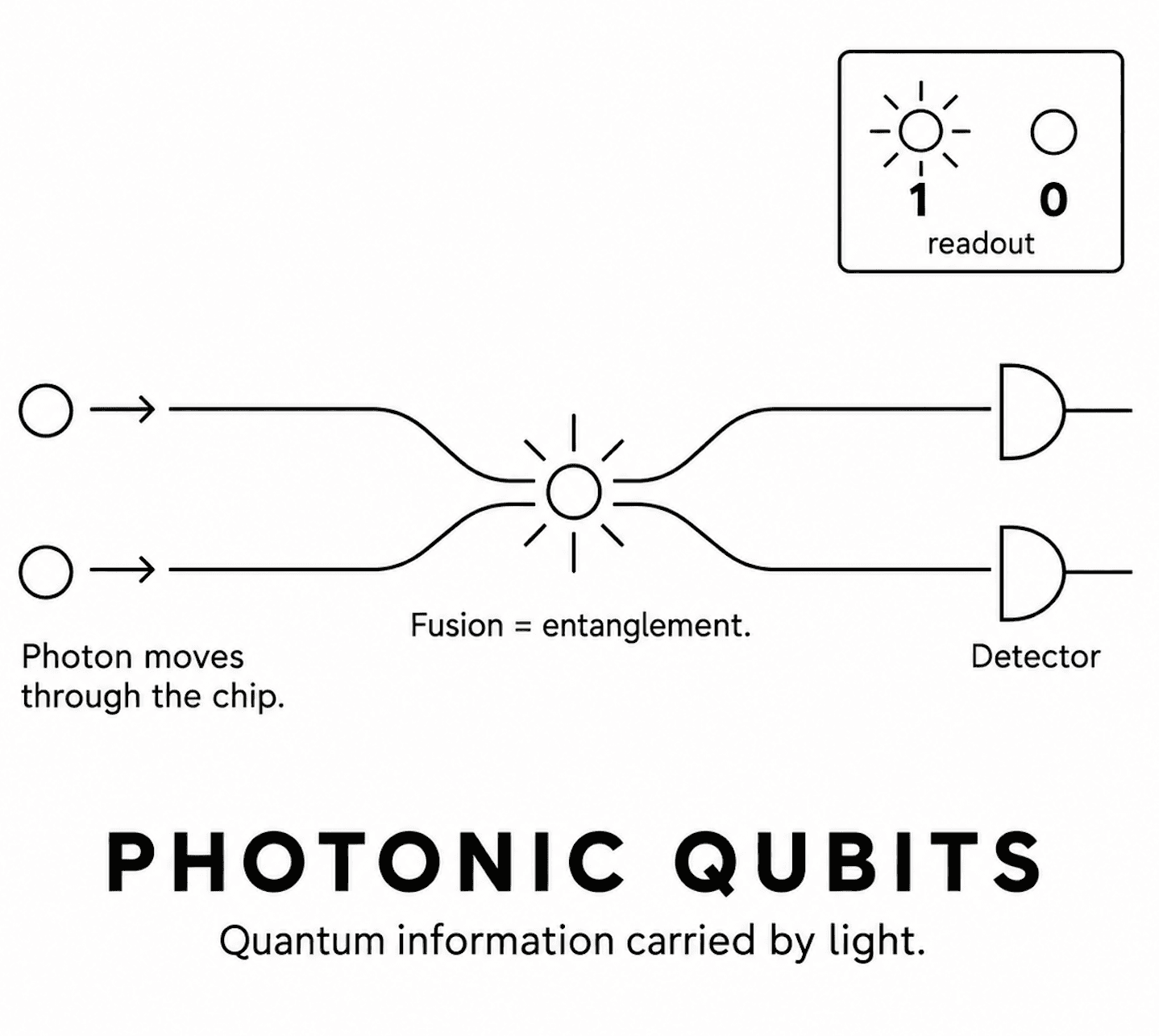
Think of the computer's quantum information as light moving through a circuit. Instead of trapping a qubit, engineers generate photons and route them through microscopic optical channels called waveguides, fabricated directly onto a chip.
How a calculation actually happens
Photons travel through networks of waveguides that guide light much as wires guide electrical signals. At carefully designed points, photons interfere quantum mechanically, and PsiQuantum's architecture uses probabilistic fusion measurements to connect photonic states and build entangled structures. Because these operations don't always succeed, the architecture relies on repeated attempts and redundancy. At readout, photon-number-resolving detectors determine where photons arrive, giving a classical 0 or 1.
Where the technology stands today
PsiQuantum's Omega photonic platform, manufactured at GlobalFoundries, reports 99.98% single-qubit SPAM fidelity, 99.5% two-photon interference visibility, 99.22% two-qubit fusion fidelity and 99.72% chip-to-chip interconnect fidelity, built for high-volume semiconductor fabrication rather than a lab prototype.
PsiQuantum broke ground in Chicago in September 2025 and in Brisbane in June 2026, pursuing systems at million-physical-qubit scale. This month, it finalised a $100 million CHIPS Act award to expand domestic manufacturing of photonic components.
A major advantage: networking and less extreme cooling
Photons are naturally suited to carrying quantum information between chips through optical fibre, making networking a natural part of this architecture. The qubits also avoid the millikelvin environment superconducting circuits require; PsiQuantum instead runs superconducting detectors and cryogenic infrastructure around 2-4 K, a very different cooling regime.
The trade-off
Photon loss is unforgiving: lose the photon and you lose the qubit. Fusion operations are also probabilistic, so the architecture needs redundancy, fast optical switching, and extremely low-loss components.
Commercially, where this sits
PsiQuantum raised a $1 billion Series E in 2025, valuing it at $7 billion, and remains private, betting on fault tolerance rather than commercialising smaller systems first. It's integrated NVIDIA CUDA-Q, reporting up to 450× faster GPU versus CPU simulation, and works with Airbus on fault-tolerant algorithms.
Maybe that's why this one is my favourite: manufacture the paths, move photons through them, and scale through optics.
Sources: PsiQuantum; Nature; US Department of Commerce; NVIDIA CUDA-Q.