
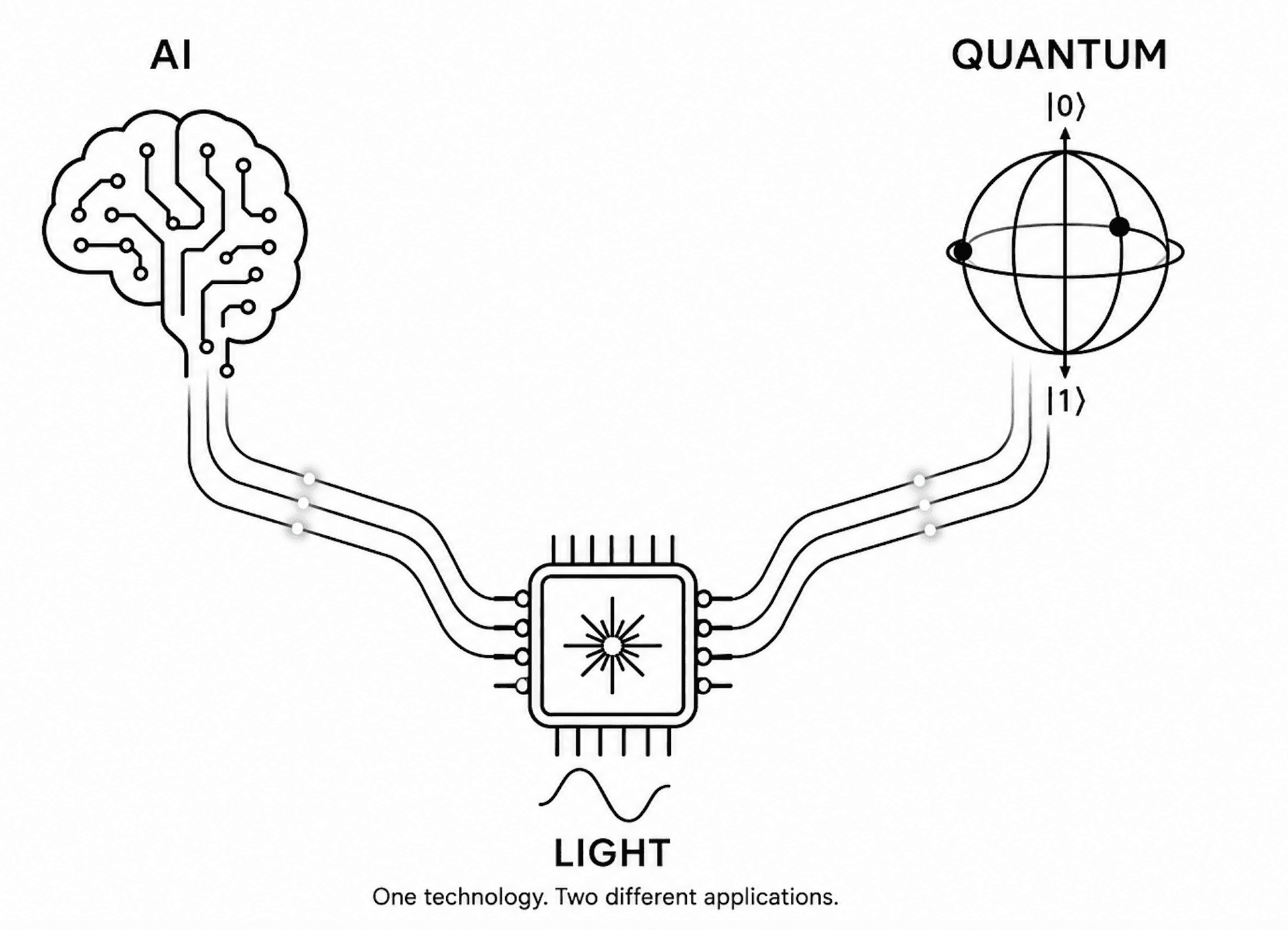
Photonic computing: using light to process information, and why it touches both AI and quantum computing.
Most conventional computer chips process information primarily using electronics, moving and manipulating electrical signals. Photonic computing uses light to carry or perform parts of that work. Photonic systems can perform certain operations through the physical properties of light itself, potentially enabling higher bandwidth and lower energy use for specific tasks.
Where it already shows up in AI
Companies like Lightmatter and Lightelligence are already commercialising photonic hardware for AI, from optical interconnects and networking to optical computing, moving enormous amounts of data between chips and systems in AI data centres. Light is already part of how modern AI infrastructure works, quietly, in the background.
Where it connects to quantum computing
This is the less obvious connection, and it's a strong one. Several real types of quantum computers already depend on light to function. Trapped-ion qubits, for example, are controlled using precisely timed laser pulses. Some other qubit platforms use optical techniques for control or readout too. An entire category of quantum computer is built directly from particles of light: photonic quantum computing. For some approaches, light carries the information itself - not just the systems around it.
Two recent examples of how fast this is moving
First: scaling optical control of many qubits can require increasingly complex external optics. In March 2026, Massachusetts Institute of Technology researchers built a photonic chip with microscopic structures nicknamed "ski jumps" that can precisely control thousands of light beams, and demonstrated the platform's ability to control qubits. The idea is compelling: move that control hardware onto a chip instead.
Second: generating, steering and reading specialised light signals traditionally requires several separate components. In May 2026, researchers at Monash University built a single chip that integrates all three functions, using a quantum degree of freedom known as ‘valley’ in atomically thin materials. That's a step toward a workable device, not just an isolated lab effect.
Neither is a finished product yet. Both are lab research.
Together, they're a useful snapshot of photonic hardware becoming an enabling technology for two major computing shifts, for genuinely different reasons in each case - and one that's rarely framed that way.
Worth noting from a talent lens: photonic hardware needs people who can work across optics, materials science, semiconductor engineering, and conventional chip design - a very different profile from a typical software team.
Sources: Li, C. et al., "An on-chip programmable valley optoelectronic nanocircuit," Nature Photonics (2026) · MIT News, on photonic control of qubits (March 2026).