
Neutral atoms
Neutral atoms: the quantum computing technology behind QuEra Computing Inc., Pasqal, and Infleqtion
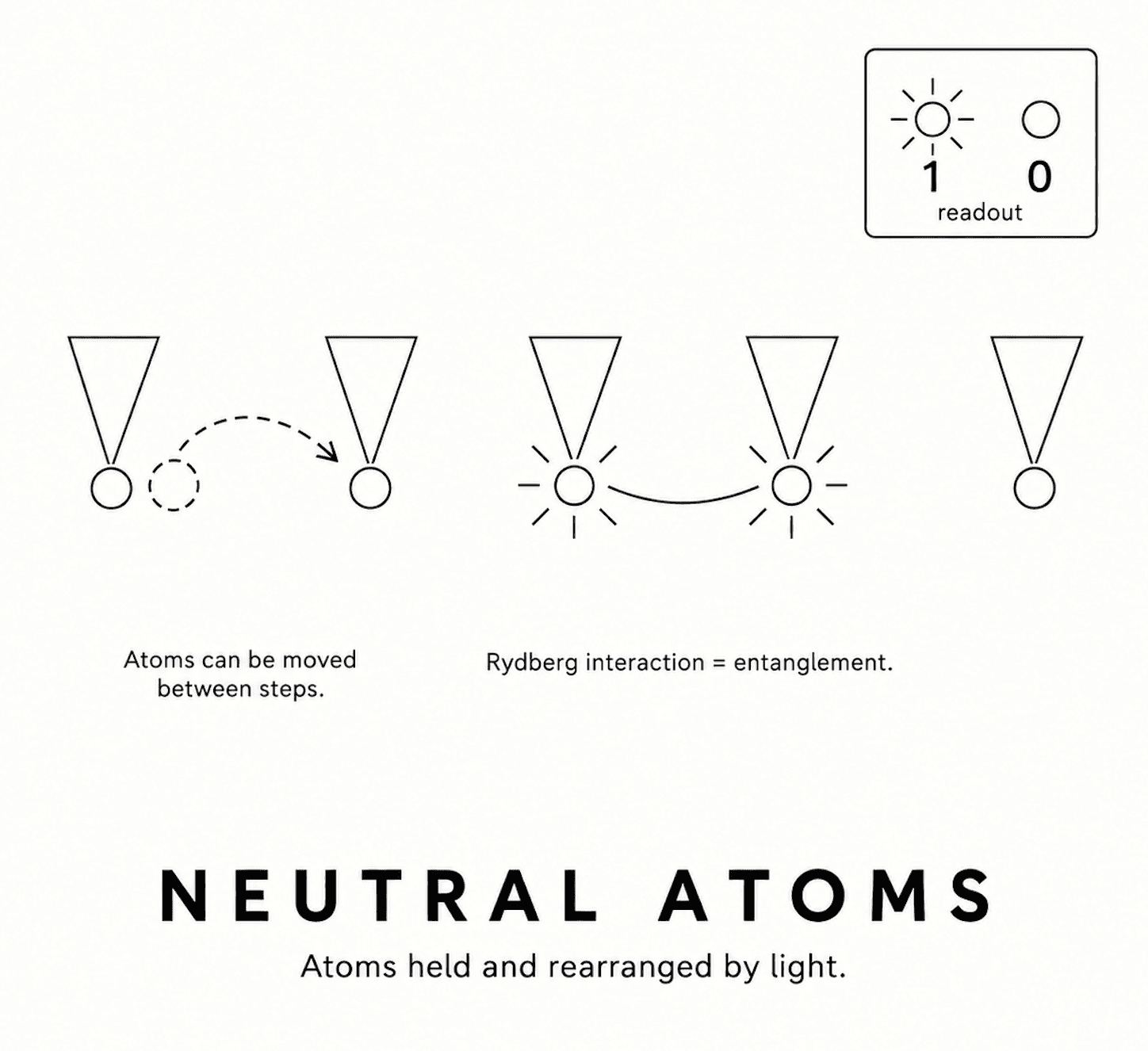
Individual atoms with no electric charge, held in a precise pattern using laser light rather than electric fields. Unlike trapped ions, these atoms aren't charged, so they're held and moved using focused laser beams called optical tweezers.
A simple way to picture it
Think of grains of sand suspended in mid-air, each pinned in place by its own beam of light, arranged into whatever pattern a calculation needs. Unlike a fixed chip layout, this pattern can be reshuffled between steps.
How a calculation actually happens
Each atom is trapped by its own optical tweezer, arranged into a grid. To interact, atoms are excited into a "Rydberg state," where the outer electron extends much further from the nucleus than normal. Nearby Rydberg atoms strongly influence each other, a phenomenon called the Rydberg blockade, creating entanglement. Because tweezers can move atoms mid-calculation, this platform can rearrange which atoms sit next to which, something fixed hardware can't do. A final laser reads each atom's state, fluorescing for one value and staying dark for the other, giving a classical 0 or 1.
Where the technology stands today
In March 2026, Pasqal integrated with NVIDIA's CUDA-Q platform, letting quantum workloads be scheduled through standard HPC systems alongside regular compute resources. In April 2026, QuEra, Harvard, and MIT researchers proposed error-correction codes that simulations suggest could approach a 2:1 physical-to-logical qubit ratio. In March, Google announced it's expanding into neutral atoms alongside its existing superconducting work. In May 2026, Infleqtion reported a record two-species entangling gate, with a theoretical path toward gate fidelities above 99.9%.
Its biggest advantage: no millikelvin refrigeration, and reconfigurable connectivity
Unlike superconducting circuits, neutral-atom systems don't require the entire processor inside a millikelvin dilution refrigerator. The atoms themselves are laser-cooled, while the surrounding system can operate at far less extreme temperatures, reducing one major infrastructure requirement compared with superconducting systems.
The trade-off
Controlling many trapped atoms with lasers is a real optical engineering challenge, and losing individual atoms mid-calculation is a failure mode this modality has to actively correct for.
Commercially, where this sits
Infleqtion went public on the NYSE in February 2026. Pasqal announced at least €340 million in financing and plans a Nasdaq listing at a $2 billion pre-money valuation. Separately, its logical qubits have outperformed physical-qubit implementations on a real differential-equation workload. Google adding neutral atoms alongside superconducting signals growing industry interest in the modality.
Sources: QuEra; Google Quantum AI; Pasqal; Infleqtion.