
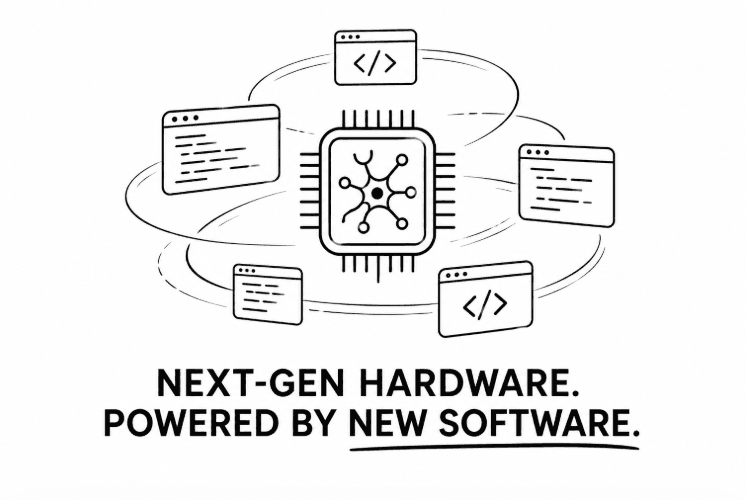
Neuromorphic computing is changing hardware. The real disruption may be software.
Neuromorphic computing is changing hardware. The real disruption may be software. Every major computing shift in the last 20 years - mobile, cloud, AI -needed more than new hardware. It needed a new way of programming that hardware. New SDKs, new frameworks, new mental models for engineers. The hardware made the shift possible, but the software made it usable.
Neuromorphic is the same pattern, early.
You can't think about programming these chips exactly like a conventional processor. Instead of designing everything around continuous computation, you're designing for events - the chip reacts when something changes, similar to how neurons fire when they receive meaningful signals. That's a genuinely different way of thinking about software, not just a faster version of the old way.
Intel has its own framework for this (Lava). Innatera has its own SDK (Talamo). There's also an emerging shared format, NIR, designed to let different neuromorphic frameworks and hardware platforms work together.
All of this is a sign of a discipline still forming in real time - which is exactly the stage where early movers can build an advantage.
A few places this is already showing up:
→ Smart buildings & safety - radar-based presence sensors that detect a person in a room without cameras, enabling privacy-preserving safety and automation systems.
→ Health wearables - continuous, always-on monitoring of signals such as heart activity, muscle signals and movement without draining a device by midday.
→ Cybersecurity research - neuromorphic systems are being explored for real-time anomaly detection, particularly where continuous streams of activity need to be monitored efficiently.
What I find particularly interesting is the software layer: most AI conversations right now are about making models bigger. This is the opposite bet - making useful intelligence run at a fraction of the power. That takes new hardware, yes - but also a different kind of software thinking, and a different kind of engineer.
And that's exactly why I keep coming back to this from a talent lens, not just a tech one. The specialist talent pool is still small compared with conventional AI and software engineering. Whoever builds that expertise early - even in small teams, even experimentally - could have real leverage when this moves from "interesting" to "standard."
Curious how many people in my network are already experimenting with this, even quietly.