
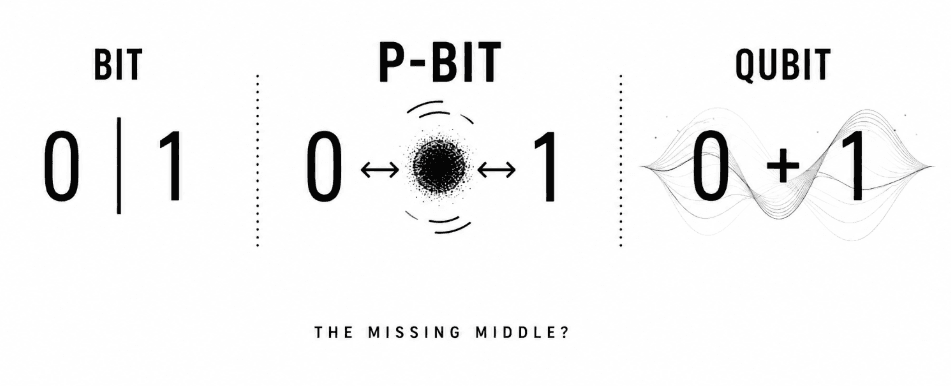
Magnetism (spintronics): bit → p-bit → qubit, the missing middle in computing.
Computing has long lived on one simple idea: a bit is either 0 or 1, nothing in between. Quantum computing introduced qubits, which can exist in a quantum superposition of 0 and 1. Now there's another approach, sitting conceptually between the two.
Spintronics is a branch of electronics that uses the magnetic "spin" of electrons, not just their electrical charge, to store and process information.
In May 2026, researchers from Tohoku University and NIST demonstrated the world's first spintronic "p-bit" integrated directly onto a silicon chip using semiconductor manufacturing techniques, rather than relying on manually assembled lab hardware.
The randomness itself is the design goal: the junction is deliberately made unstable, so it fluctuates on its own, driven by the unpredictable behaviour of a tiny nanomagnet, rather than software calculating a random number.
How does this compare to quantum:
Researchers describe p-bits as sitting conceptually between a normal bit and a qubit. Many leading quantum computers require extreme cooling. A p-bit is genuinely probabilistic too, but can operate at room temperature on conventional semiconductor hardware - less exotic, but potentially closer to practical manufacturing.
Why it matters:
Most conventional computers aren't designed to efficiently explore huge numbers of possible solutions at once. Many real problems, like routing or scheduling, are really "explore many options to find the best one" problems. A chip built from many p-bits can explore a large solution space in parallel, using physics to generate randomness instead of calculating it, with potentially very low energy use.
A concrete example already published: researchers built a probabilistic computer for molecular docking, a key drug discovery step where software searches enormous numbers of ways a molecule could bind to a target protein. The work positions probabilistic computing as a potential alternative to quantum approaches for this type of problem.
The breakthrough is in the manufacturing, not the concept - large p-bit systems have already been demonstrated. What's new is showing that a spintronic p-bit can be integrated with semiconductor circuitry on a silicon chip, opening a path toward scaling.
This builds on manufacturing know-how from related spintronic technologies such as STT-MRAM, which is already being produced at scale.
Worth noting: this also requires a different kind of engineer, comfortable with probability and physics alongside conventional digital logic. That's a small, emerging talent pool, similar to what we're seeing across neuromorphic and quantum hardware.
This is one verified component. Building a large, reliable network of many identical p-bits at scale remains a real engineering challenge.
Sources: Yoon et al., IEEE Electron Device Letters, May 2026 · Tohoku University, June 2026.