
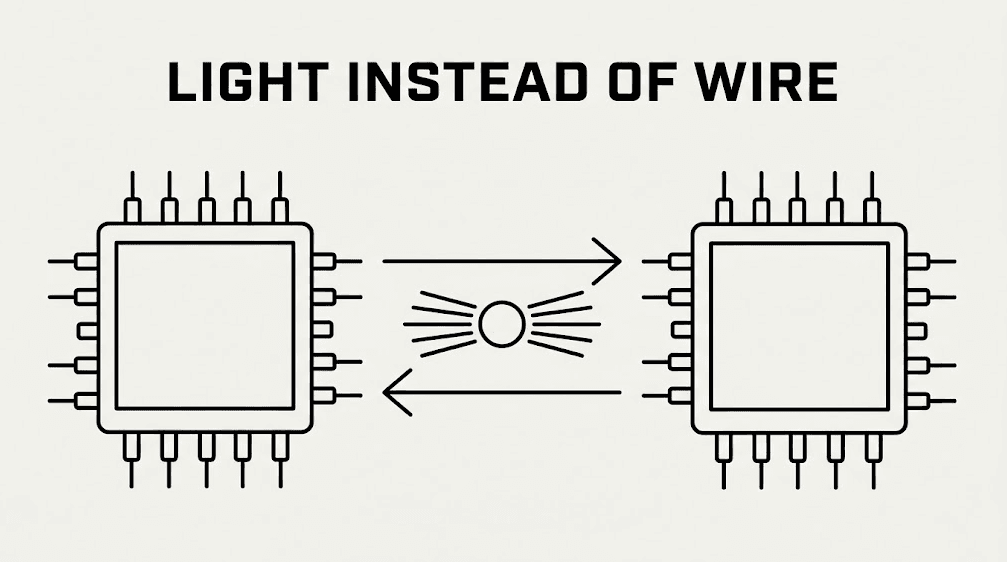
Light instead of wire.
Light instead of wire: quantum computing is running into a similar interconnect bottleneck classical computing is only now starting to fix.
Earlier this year, researchers achieved a genuine milestone: photonically interconnecting two separate, independent quantum systems, using light instead of electrical connections to link them together.
The bottleneck
A useful quantum computer will likely need many chips working together, not one giant chip. But connecting quantum chips is harder than connecting classical ones: preserving the required quantum states while connecting separate processors is a much harder engineering problem.
The same wall exists in classical computing, at a much larger scale
This isn't a quantum-only problem. Every large computing system, quantum or classical, ultimately needs to move data between physically separate chips, and the electrical parts of these connections are becoming a bottleneck. In today's data centers, AI workloads have pushed chips to get dramatically faster, while moving data between them increasingly creates challenges around bandwidth, latency, and energy consumption.
The fix, in both cases: light instead of wire
Photonics swaps the medium of transport from electricity to light, and it's being adopted on both sides of this comparison. In quantum computing, this year's milestone validated the generation, transmission, and detection of photons used to entangle two commercial quantum systems at a distance, demonstrating connected, commercial quantum systems. In classical computing, the same shift is already underway commercially: next-generation AI computing platforms are integrating optical connectivity directly into networking hardware, reducing the electrical signalling burden at scale.
Where this stands commercially today
On the classical side, this is actively rolling out, not finished, with real hardware entering next-generation AI platforms. On the quantum side, it's still early: photonic interconnects between quantum computers exist as validated milestones and lab demonstrations, not yet standard commercial infrastructure, and most quantum systems today still operate as isolated processors rather than networked ones.
What comes next
Quantum computing may end up following the same infrastructure path classical computing is already on: separate chips connected over standard fiber, the way data centers already connect servers today, rather than needing some entirely new kind of physical wiring. Two different computing paradigms, facing increasingly difficult interconnect problems, and converging on the same idea: move information with light.
Sources: IonQ, "IonQ Achieves First Photonic Interconnect Milestone" (April 2026); NVIDIA, "Silicon Photonics Networking for Agentic AI" (2026); IDTechEx, "Silicon Photonics and Photonic Integrated Circuits 2026-2036."