
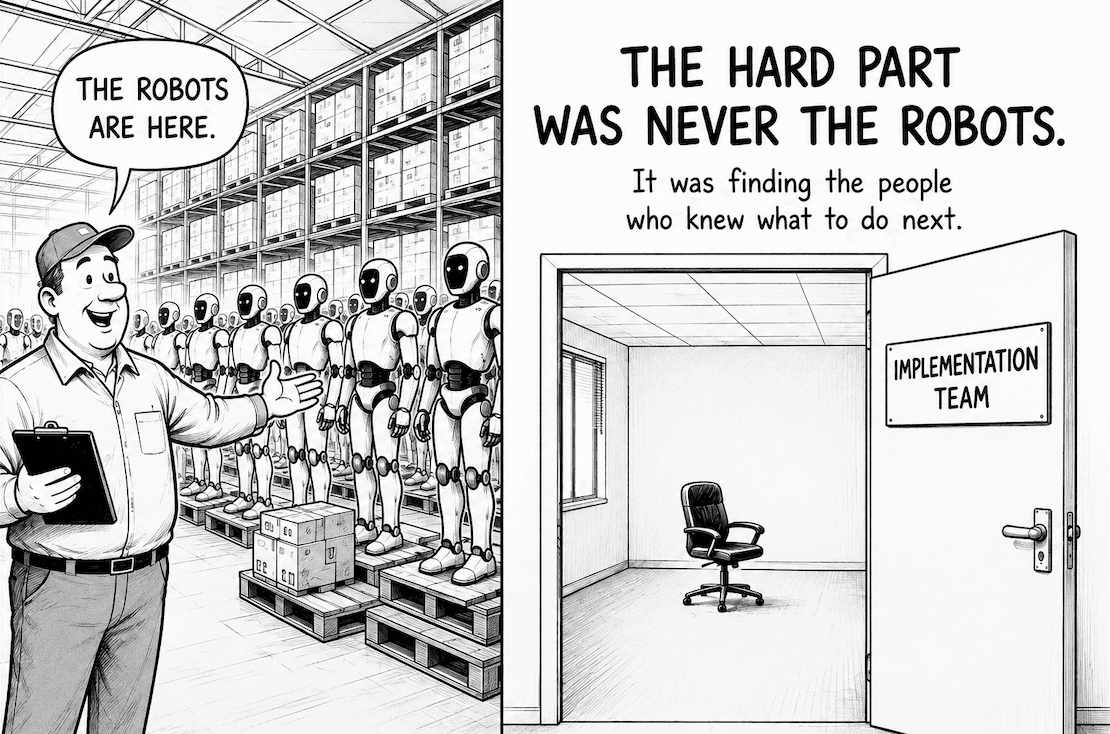
ERP. CRM. AI. Now robotics.
China produced over 40,000 humanoid units in H1 2026.
Specialised, single-task units are moving into factories. General-purpose units are proving much harder to deploy because they require extensive secondary software development by the customer. The market simply doesn't have enough engineers with the expertise to do it at scale.
Figure AI in the US is one interesting data point on the other side. They've shipped a fraction of that volume, but they build their own actuators, run their own model, and integrate through their own engineers on-site at BMW. No handoff. No unsold inventory.
Every time a new technology reaches the market, the same bottleneck shows up. It's rarely the technology. It's that nobody outside the company that built it knows how to implement it, and the market hasn't produced those specialists yet. Until the vendor either trains that market or does the implementation itself, the product stalls, no matter how good it is.
And it's the clearest right now in AI infrastructure.
Palantir Technologies built its entire commercial model around this. Instead of selling Foundry and letting the customer's team implement it, they embed their own engineers on-site until it runs in production.
It's called Forward Deployed Engineering.
The model is spreading. Anthropic and OpenAI are both building customer engineering functions that serve a similar purpose, for the same reason Palantir did in 2003: a technical platform meeting a buyer who doesn't have the people to run it isn't a sales problem. It's an implementation gap, and someone has to close it.
The pattern holds across all four.
Scaling a breakthrough technology means scaling who can deploy it - in-house, through partners, or across an ecosystem. Skip that, and the product stalls no matter how good it is.
Technology scales when talent scales with it.
References: Deep Tech Industry Report (2026); Brightwork Research; Everest Group; BigGo Finance.