DNA Data Storage: The archive that could outlive everything we build today
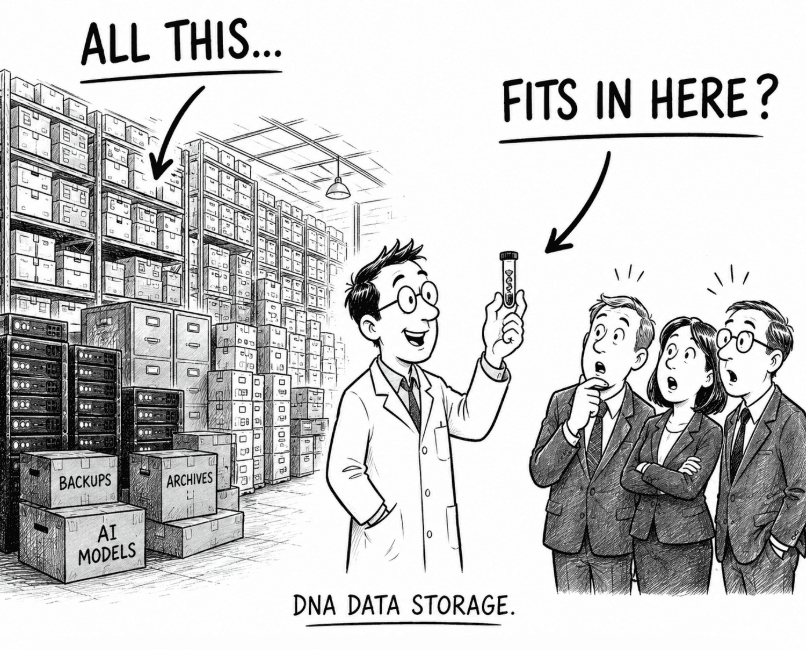
A gram of DNA could theoretically hold the equivalent of data from thousands of modern laptops. Not a lab fantasy - companies are already turning this into real storage products.
A realistic near-future case: archiving a decade of AI model checkpoints that a company chooses or is required to retain but rarely accesses. Encode it once, store it, leave it - potentially more cost-effective over decades, with a much smaller physical footprint than conventional storage.
This is no longer just a laboratory concept. In March 2026, Biomemory - already selling DNA storage cards - acquired CATALOG, a Boston pioneer in the space, combining their manufacturing and reading technologies. The company plans to launch its first data-centre-ready DNA storage system before the end of 2026, moving from research curiosity towards infrastructure that could sit alongside traditional storage systems.
What it actually is
DNA storage uses synthetic DNA - lab-manufactured, not taken from any living organism - built from four molecules (A, C, G and T), the same "alphabet" used by natural DNA.
To store data, a digital file is converted into a sequence of these letters, then manufactured as a synthetic DNA strand. To read it back, the DNA is sequenced and converted back into digital data. No magic - just a different alphabet that is remarkably dense and durable.
Three things make it worth the effort: density (a small tube can hold what would fill a warehouse of drives), longevity (potentially preserving information for centuries under suitable conditions), and zero power once written.
The catch is speed. Writing and reading take minutes to hours, not milliseconds. That makes DNA storage suitable for information you rarely access but cannot afford to lose: legal archives, scientific records, and increasingly, older AI model versions and training data.
The talent question:
This is where it gets interesting from where I sit. DNA storage is projected to be one of the faster-growing storage markets over the next decade, yet it sits in an unusual hiring gap: not quite biotech, not quite data engineering.
The closest existing path today is bioinformatics - people who already combine biology, programming, and data pipelines. But DNA storage will likely require something even more specialised: engineers who understand both molecular encoding and modern data infrastructure. That job title barely exists today.
For companies exploring this early, the people you need probably won't come pre-labelled. You'll be hiring from adjacent disciplines and building the specialist expertise on the job - exactly the kind of talent gap I find most interesting to solve.
References
Biomemory / Catalog Technologies acquisition announcement, March 2026
DNA Data Storage Market Forecast, Global Market Insights, 2026