
Computers that don't rely on electricity for every part of computation.
Researchers are trying to build computers that don't rely on electricity for every part of computation. Here's why.
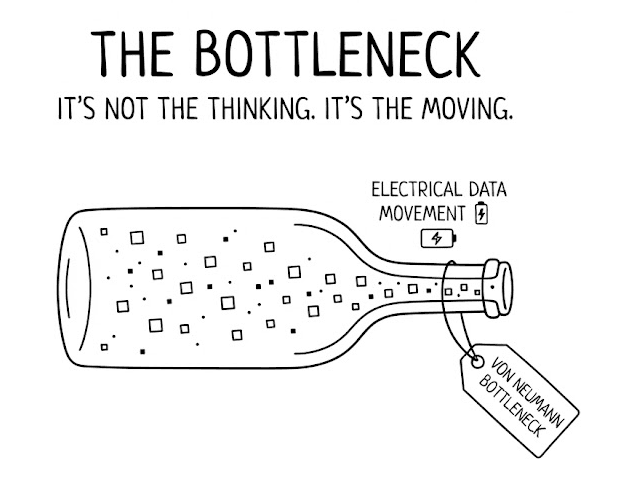
Every computer running today's AI faces one challenge: constantly moving data between memory and processor. That costs energy every time - the von Neumann bottleneck, built into most modern computers.
This mattered less when workloads were small. It matters now: data centre electricity use is projected to more than double by 2030, with AI-driven computing growing even faster.
Neuromorphic computing is one response - bringing memory and computation closer together, using power only when something meaningful happens, closer to how a brain works.
But it raises a deeper question: if moving information electrically is part of the inefficiency, why not compute with something else? Some physical mediums move or process information at lower energy cost - the tradeoff is starting over on manufacturing and reliability that silicon has spent decades solving.
That's why several physical approaches are being explored in parallel:
𝘓𝘪𝘨𝘩𝘵 (𝘱𝘩𝘰𝘵𝘰𝘯𝘪𝘤𝘴) - one of the most advanced. Light performs certain calculations just by travelling through the right structure, with very low energy loss. Working photonic AI chips already exist, and researchers have now demonstrated on-chip training in photonic neural networks - a step toward making it scalable.
𝘔𝘢𝘨𝘯𝘦𝘵𝘪𝘴𝘮 (𝘴𝘱𝘪𝘯𝘵𝘳𝘰𝘯𝘪𝘤𝘴) - a quieter, longer-running effort. Magnetic devices can combine memory and computation, though scaling and reliability remain challenges.
𝘚𝘰𝘶𝘯𝘥 (𝘢𝘤𝘰𝘶𝘴𝘵𝘪𝘤𝘴) - the newest entrant. Researchers recently demonstrated an "acoustic synapse" that classified faster and with substantially lower power than comparable electrical systems - real, but still lab-stage.
The pattern: each is chasing the same goal from a different angle - a physical medium whose natural behaviour does more of the computation itself, instead of relying on digital operations for every step.
Photonics already has real hardware and companies behind it. Spintronics has progressed steadily for years. Acoustics is still early-stage.
Which is also why software matters. Frameworks like NIR - a common representation letting neuromorphic models move between simulators and hardware - could become essential if this becomes usable at scale.
The future of computing may not be about making silicon do everything faster - it may be about choosing a better physical medium for the job.
Sources: IEA - Energy and AI; Nature - photonic training; Nature Communications - NIR; Science Advances - acoustic synapse.