
Acoustic computing: What if a chip could "think" in sound?
Researchers at the University of Arizona built a working "acoustic synapse" - a device that processes information using sound waves instead of electricity, using acoustic waves to perform part of the computation that would normally be handled electronically. The device operates around 54–66 kHz, per the published study.
Why it matters
Reporting on the study describes the device being tested on standard classification benchmarks, including sorting iris flowers by species and recognising handwritten digits. Against conventional neural-network hardware, it converged faster, used fewer parameters, and consumed a fraction of the power. The paper describes hybrid analog-digital control, so this isn't a full break from digital processing, but a shift toward doing more of the work in the acoustic domain itself.
Now, let me imagine forward - this is speculation, not what the paper demonstrates:
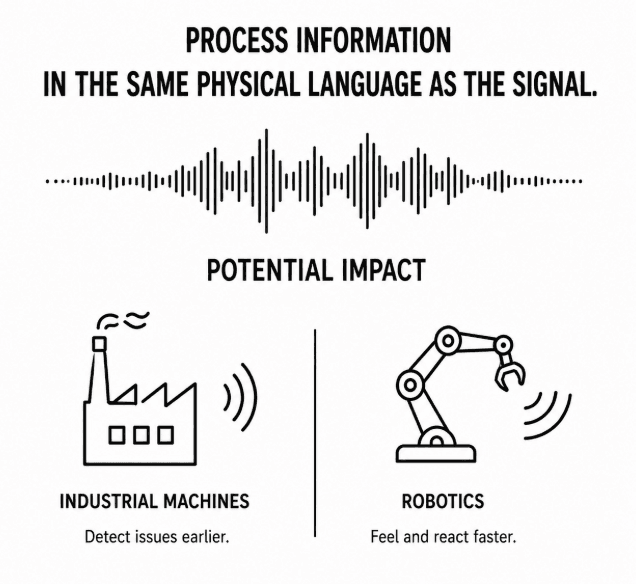
The longer-term possibility is what I find most interesting: acoustic signals could potentially be processed in their native physical domain before conventional digitisation and downstream computing. Industrial machines already "speak" in vibration - a motor developing a fault often vibrates differently weeks before it fails. Today, catching that means a sensor, then a separate chip to digitize and process the signal. An acoustic chip could potentially fold part of that processing into the sensing layer itself. Fewer components, less power, sensors that could run years longer on one battery.
Robotics could benefit the same way. A gripper losing its grip, a joint straining, a foot slipping - a robot "feels" this as vibration before any camera catches up. An acoustic chip in the joint could process that feeling closer to where it happens, rather than routing it to a central processor first.
Worth being honest: those benchmarks are clean lab tests, not noisy factory floors. Scaling from the demonstrated device to a large, interconnected computing architecture remains an open engineering challenge. As with many analog and wave-based computing approaches, precision, noise, and reproducibility will be important questions as the technology scales.
Arizona also hosts NewFoS, an NSF-funded research centre pursuing topological acoustics, backed by a five-year, $30 million NSF grant.
If it clears these hurdles, the real gain is fewer components - sensors that process information in the same physical language as the thing they're sensing.
Sources: Chen, J. et al., "Topological acoustic synapse for high-dimensional neuromorphic computing," Science Advances (2026) · University of Arizona Tech Launch Arizona.